
 +1 844-445-5767
 +971 56-848-5757
 +91 921-208-0630
For Business & Service Inquiries
Sales Team
Project quotes, partnerships, implementation
Every healthcare CIO and IT director eventually faces the same fork in the road: do you build your own cybersecurity team, or do you bring in a managed security services provider to do it for you? On the surface, it seems like a simple build-vs-buy decision. But in reality, it is one of the most financially and operationally consequential choices your organization will make in 2025 and beyond. Here is the part most vendors and analysts quietly skip over: the true cost of each option is almost never what it looks like on paper. The salary ranges, the licensing fees, the tool budgets — those are the visible numbers. The hidden costs — talent attrition, compliance gaps, breach response, 3 a.m. escalations with no one on shift — are where organizations bleed money without ever connecting the dots back to their security model. This blog breaks down both options with real numbers, a healthcare-specific lens, and the kind of honest comparison that helps you make a decision your CFO and your compliance officer will both respect. What Each Model Actually Looks Like in Practice Before comparing costs, it is worth being precise about what you are actually comparing. An in-house security team means your organization directly employs the analysts, engineers, and architects responsible for monitoring, detection, response, and compliance. You own the tools, you manage the talent, and you carry the full operational overhead. For 24/7 coverage — which any healthcare organization handling ePHI genuinely needs — that means multiple analysts working rotating shifts, a SOC manager, and a technology stack that ranges from SIEM platforms to endpoint detection tools. A managed security services provider (MSSP), by contrast, delivers those same functions as a subscription. Your provider operates a shared or dedicated security operations center, employs the analysts, maintains the tools, and monitors your environment around the clock. You pay a predictable monthly or annual fee rather than carrying the payroll, benefits, training, and infrastructure costs internally. Both can work. But the financial and operational reality of each is dramatically different — and for healthcare organizations operating under HIPAA, the compliance dimension adds another layer of complexity that tips the scales in ways most organizations do not fully anticipate. The Full Cost of Building an In-House Security Team Let us put real figures to what a functional in-house security operation actually requires for a mid-sized healthcare organization. Staffing Costs The U.S. Bureau of Labor Statistics reported the median annual salary for information security analysts at $124,910 in May 2024, with senior threat hunters and SOC leads pulling considerably higher. Running three analyst tiers plus a SOC manager across genuine 24/7 coverage requires a minimum of six analysts—eight is more realistic if you want sustainable shift rotations without burning people out. Six analysts at median costs of $749,460 per year before benefits, bonuses, or overtime. Add benefits, employer taxes, and bonuses—typically 30–35% on top of base salary—and your personnel line alone approaches $1 million annually before you have hired a SOC manager, a CISO, or a compliance officer. Technology and Infrastructure A functional SOC requires a SIEM platform, endpoint detection and response (EDR/XDR) tools, threat intelligence feeds, vulnerability management software, and network monitoring capabilities. Technology licensing and maintaining core security tools may add $300,000 to $1 million or more per year. Training, Certifications, and Retention Cybersecurity certifications are not optional in a regulated environment. CISSP, CISM, CEH, and HIPAA-specific training are recurring costs. And even after investing in training, healthcare organizations are watching those investments walk out the door. A Black Book Research survey found that 74% of healthcare organizations reported significant cybersecurity staff attrition over the past year. 90% of cybersecurity professionals exiting healthcare cited substantially higher compensation and reduced stress in technology and finance sectors. Every time a trained analyst leaves, you absorb recruitment costs, onboarding time (typically 3–6 months before full productivity), and a coverage gap that creates real exposure. Total Annual In-House SOC Cost Ponemon Institute research suggests the average annual cost of operating an in-house SOC can be around $2.84 million. Industry analyses broadly place the range for a fully functional in-house SOC at between $1 million and $4 million annually depending on organizational size. For most healthcare organizations outside the largest enterprise health systems, that number represents an unsustainable portion of the IT security budget. What Managed Security Services Actually Cost The pricing range for managed security services is wide because the scope of services varies significantly. Here is how the numbers break down across organization sizes. On average, businesses can expect to pay between $3,000 and $30,000 per month for MSSP services. For organizations requiring advanced services such as extended detection and response (XDR) or ongoing compliance management, costs may be higher. For healthcare-specific coverage that includes HIPAA compliance monitoring, incident response, and 24/7 SOC operations: Small healthcare organizations (under 500 employees): $60,000 – $150,000 per year Mid-sized health systems (500–2,000 employees): $150,000 – $360,000 per year Large enterprise healthcare (2,000+ employees): $360,000 – $600,000+ per year A genuine 24/7 in-house SOC costs $1.2 million to $2.5 million per year. SOC-as-a-Service covers the same ground for $60,000 to $300,000. Organizations implementing outsourced SOC services reported saving an average of $2.22 million compared to maintaining internal security teams without automation capabilities. The math is not subtle. For most healthcare organizations, the managed security services cost is 20–40% of what the equivalent in-house operation would run. But the cost comparison is only the beginning of the story. The Hidden Costs Nobody Puts in a Spreadsheet This is the section most cost-comparison posts skip. The visible costs are easy to model. The hidden costs are where healthcare organizations consistently underestimate their exposure. Coverage Gaps on Nights and Weekends Ransomware does not operate on business hours. The majority of attacks are initiated outside of standard working hours precisely because most in-house teams are not fully staffed around the clock. If your team covers 8 a.m. to 6 p.m. Monday through Friday, you have roughly 128 hours per week of reduced coverage. An MSSP operating a 24/7 SOC closes that window entirely. Tool Sprawl and Underutilization Over 80% of healthcare organizations polled admitted that cybersecurity investments are underutilized due to staffing shortages, wasting millions in technology spend. You can pay for a best-in-class SIEM platform, but if your analysts do not have the bandwidth or the expertise to tune it properly, you are paying for a fire alarm that only goes off when the building has already burned down. Incident Response and Breach Costs When an in-house team cannot contain an incident quickly — often because of staff limitations or tool gaps — the escalation costs grow exponentially. Forensics firms, outside legal counsel, regulatory notification procedures, and breach remediation all compound rapidly. Hospitals can lose up to $900,000 per day during downtime, when surgeries, prescriptions, and claims are disrupted. An incident that an MSSP's 24/7 team might detect and contain in two hours can turn into a 72-hour outage for an under-resourced in-house team — and that difference in detection time is the difference between a manageable incident and a catastrophic one. The Talent Shortage Premium The global cybersecurity workforce gap has hit a record 4.8 million unfilled roles — a 19% year-over-year increase. Organizations with significant security staff shortages face data breach costs that are, on average, $1.76 million higher than their well-staffed counterparts. When your open roles stay open, your risk premium is not theoretical. It is measured in breach cost differentials. Emerging Cyber Threats Demand Continuous Skill Updates The threat landscape evolves faster than most internal training budgets can keep pace with. AI-driven attacks, supply chain compromises, and emerging cyber threats require analysts who are constantly updated on new techniques and attack vectors. An MSSP's entire operating model is built around staying current because their reputation and client retention depend on it. An in-house team's training budget is often the first thing cut when IT costs come under scrutiny. Healthcare-Specific Compliance: HIPAA, Legal Risk, and What It Costs to Get It Wrong For healthcare organizations, cybersecurity is not just an IT concern — it is a legal and regulatory obligation that carries direct financial penalties. HIPAA Enforcement Is Accelerating OCR investigates all breaches affecting 500 or more individuals and assesses whether they were due to noncompliance with the HIPAA Rules. There was a dip in HIPAA enforcement activity in 2023, but enforcement actions increased in 2024 and 2025, peaking in 2026 when 772 healthcare data breaches affecting 500 or more individuals were reported to OCR. The enforcement pattern in recent years is clear: OCR is not just penalizing organizations for breaches. It is penalizing them for the absence of a documented, enterprise-wide security risk analysis — regardless of whether the breach itself was preventable. A review of recent multi-million-dollar settlements reveals a consistent theme: OCR is penalizing organizations for the failure to conduct a thorough, enterprise-wide security risk analysis. This failure is cited as a core violation regardless of whether the breach itself was caused by ransomware, phishing, or an insider threat. A robust managed cyber security services engagement typically includes ongoing risk analysis, documented remediation, and audit-ready compliance evidence — exactly what OCR expects to see when investigating a breach. HIPAA Penalties: The Financial Scale HIPAA civil penalties are tiered by culpability: Unknowing violation: $137 – $68,928 per violation Reasonable cause: $1,379 – $68,928 per violation Willful neglect (corrected): $13,792 – $68,928 per violation Willful neglect (not corrected): $68,928 – $2,067,813 per violation When a breach affects tens of thousands of patients — as the largest healthcare incidents do — these per-violation figures compound into multi-million-dollar settlements rapidly. The Proposed HIPAA Security Rule Overhaul A proposed overhaul of the HIPAA Security Rule introduced by the Department of Health and Human Services is expected to mandate stringent cybersecurity standards, including multi-factor authentication, ePHI encryption, and rigorous annual compliance audits. Healthcare providers, already struggling with limited cybersecurity staffing, face enormous compliance pressures as the final rule awaits implementation. For organizations relying on an in-house team that is already stretched thin, meeting these new requirements will likely require either significant investment in additional headcount and tooling — or a pivot to a managed services model that has compliance built into the service delivery framework. Zero Trust as a Compliance Architecture Regulators and security frameworks increasingly point to zero trust security solutions as the architecture best suited to protecting ePHI in complex, interconnected healthcare environments. Zero trust assumes no user or device is inherently trusted, verifying continuously rather than relying on perimeter defenses. Implementing this architecture in-house requires specialized expertise that most healthcare organizations simply do not have on staff. MSSPs that specialize in healthcare can deploy and manage zero trust frameworks as part of the service engagement. Healthcare Case Study: When the In-House Model Failed The following scenario is constructed from patterns documented across multiple real-world incidents reported by HIPAA Journal, IBM, and Netwrix. Regional Health System — Midwest, USA A regional health system with approximately 1,200 employees maintained a six-person in-house IT security team. The team was competent but stretched across security, IT operations, and helpdesk functions simultaneously. They ran a basic SIEM tool and conducted quarterly vulnerability scans. In early 2024, a phishing campaign targeting a business associate credential allowed threat actors to move laterally through the network for 23 days before detection. The attack encrypted patient scheduling systems and accessed approximately 340,000 patient records. Total impact: Breach remediation and forensics: $1.4 million HIPAA OCR settlement: $875,000 Patient notification and credit monitoring: $420,000 Downtime costs across 11 days of operational disruption: $9.9 million (at ~$900,000/day) Reputational and patient attrition impact: unquantified A post-incident review determined that the lateral movement would have been flagged within hours by a 24/7 SOC with behavioral analytics — standard in most MSSP service tiers. The cost of a mid-tier managed security engagement for that organization would have been approximately $180,000 per year. The math: $12.6 million in incident costs vs. $180,000 in annual managed security investment. Side-by-Side Comparison Guide: MSS vs In-House for Healthcare Category In-House Team Managed Security Services Annual Cost (Mid-Size Healthcare) $1.2M – $2.8M $150,000 – $360,000 24/7 Coverage Requires 6–8 FTEs minimum; often not achieved Included as standard HIPAA Compliance Support Dependent on internal expertise Built into healthcare-focused MSSP engagements Threat Intelligence Access Limited to in-house feeds and vendor updates Shared intelligence across MSSP client base Incident Response Capability Limited by team size and availability Dedicated IR team on retainer Tool Maintenance Full burden on internal team Managed by MSSP Scalability Requires hiring (3–6 months lead time) Scales with contract scope Talent Attrition Risk High — especially in healthcare Low — absorbed by MSSP Regulatory Audit Readiness Variable Documented, audit-ready as standard Zero Trust Implementation Requires specialized hires Available as managed service Detection Speed (Avg) Hours to days Minutes to hours Breach Cost Liability Fully absorbed Shared/mitigated through faster detection Industry Report Snapshot: Healthcare Cybersecurity The data tells a consistent story about where healthcare cybersecurity risk is concentrated and why the in-house model struggles to keep pace. The average cost of a healthcare data breach in 2024 was $9.8 million. Breached healthcare information can be up to 50 times more valuable than financial information. Complete medical information can sell for up to $1,000 on dark web marketplaces. Nearly half — 48% — of healthcare organizations experienced at least one cybersecurity incident over the past year. Healthcare breaches cost an average of $7.42 million per incident, the costliest of any industry. The number of healthcare organizations reporting cyberattack losses exceeding $200,000 nearly quadrupled between 2024 and 2025. Attacks costing more than $500,000 occur twice as often in healthcare as in all other sectors. Healthcare organizations experienced their costliest year on record, with total industry losses exceeding $21.9 billion from ransomware downtime alone — representing a 340% increase in financial impact compared to 2019 baseline measurements. On the talent side: In 2025, there are an estimated 3.5 million unfilled cybersecurity positions worldwide, with U.S. businesses struggling to fill about 500,000 security roles. 88% of organizations surveyed experienced at least one significant security incident in the past year due to skills shortages. For healthcare organizations specifically, the workforce crisis is compounded by compensation competition from finance and technology sectors that can offer significantly higher salaries. An in-house model that depends on attracting and retaining talent is operating against structural headwinds that are not improving. Organizations in regulated markets, including those seeking cybersecurity services Australia, face an additional compliance layer from frameworks like the Australian Privacy Act and the Notifiable Data Breaches scheme — both of which parallel HIPAA in their expectation of documented risk management and timely breach notification. The talent and compliance pressures apply globally, and managed services designed around regulatory compliance address them regardless of jurisdiction. Which Model Fits Your Healthcare Organization? The right answer depends on your organization's size, existing infrastructure, compliance maturity, and risk tolerance. Here is a practical framework for deciding. Choose Managed Security Services if: Your organization has fewer than 2,000 employees and cannot sustainably staff and retain a full 24/7 SOC You are facing HIPAA audits or have received OCR correspondence and need documented, defensible compliance evidence quickly You have experienced staff attrition that has left critical security roles vacant for 90 days or more Your current detection and response capability is dependent on business-hours coverage You are undergoing a digital transformation — cloud migration, EHR modernization, IoT expansion — that requires security architecture expertise you do not have internally You want predictable, budgetable security costs rather than variable headcount and licensing expenses Consider In-House (with MSSP augmentation) if: You are a large health system with an existing, mature SOC and the budget to sustain it You have regulatory or contractual requirements that mandate internal control of certain security functions You are willing to invest in the talent pipeline, compensation packages, and retention programs necessary to compete for cybersecurity professionals against technology sector employers In most cases, the honest answer for mid-sized healthcare organizations is a hybrid model: a lean internal team focused on governance, vendor management, and strategic oversight, supported by a managed security provider that delivers 24/7 monitoring, incident response, and compliance documentation. How SISGAIN Helps Healthcare Organizations Close the Gap SISGAIN delivers managed cybersecurity services purpose-built for healthcare organizations navigating HIPAA compliance, expanding digital infrastructure, and an increasingly hostile threat environment. Our healthcare security practice covers: 24/7 Security Operations Center monitoring with healthcare-specific threat intelligence HIPAA compliance support including risk analysis documentation, audit trail management, and breach notification workflows Zero trust architecture design and managed implementation for ePHI environments Incident response retainer with guaranteed SLAs for healthcare clients Vendor and business associate risk management — a critical control point given that a significant share of healthcare breaches originate at the business associate level We work with health systems, specialty practices, medical device manufacturers, and digital health companies across North America and globally. Our team brings direct HIPAA, HITRUST, and SOC 2 experience, not generic IT security applied to a healthcare context. If you are currently evaluating the managed security services cost against the fully-loaded cost of your in-house model — including the hidden costs documented in this article — we are happy to run that analysis with you in a no-obligation consultation. Final Thoughts: The debate between managed security services and an in-house team is often framed as a question of control. In reality, for most healthcare organizations, it is a question of whether the control you think you have is actually delivering the protection you need. For many small to mid-sized organizations, a single IT hire costs more than an entire managed service provider team and delivers less protection, coverage, and ROI. Control can be an illusion. The data on healthcare breach costs, talent shortages, compliance penalties, and detection speed gap points in one direction: for healthcare organizations without the budget and infrastructure of a major enterprise health system, managed security services deliver materially better security outcomes at a fraction of the cost. The hidden costs are not hidden once you look for them. Breach remediation, HIPAA settlements, operational downtime, and the compounding cost of talent attrition make the in-house model's true price tag far higher than the salary budget line suggests. The question is not whether you can afford managed security services. It is whether you can afford not to have them.
Penetration Testing Guide for Australian Businesses in 2026 Cyber risk has become a board-level concern for Australian businesses, and 2026 is no exception. Ransomware crews now target small and mid-sized companies, not just enterprises. Cloud misconfigurations expose sensitive data overnight. Web application vulnerabilities give attackers a quiet way in. On top of that, compliance pressure keeps rising, and customers expect their personal information to stay protected. This is where penetration testing earns its place. A cyber security penetration test shows you exactly how an attacker could break into your systems, before a real one does. It moves you from guessing about your security to knowing where you stand. Understanding the wider landscape of cybersecurity threats for Australian businesses helps put penetration testing in context, because testing is most useful when it targets the risks that matter most to your organisation. This guide explains what penetration testing is, the types available, how the process works, what it costs, and how to choose the right provider. What Is Penetration Testing? Penetration testing is a controlled security assessment where skilled ethical hackers try to break into your systems using the same techniques real attackers use. They test applications, networks, cloud systems, APIs, devices, and infrastructure to find exploitable weaknesses, then report them so you can fix the gaps. Think of it as a planned, authorised attack carried out by people on your side. Nothing is destroyed and no data is stolen. Instead, the testers prove what an attacker could realistically achieve and document the path they took. The result is clear, practical evidence of your security posture rather than a theoretical checklist. Penetration Testing Purpose The penetration testing purpose goes well beyond ticking a box. A good test helps you: Find vulnerabilities that can actually be exploited, not just flagged Measure real-world risk by showing how far an attacker could get Improve cyber resilience by closing genuine gaps Support compliance and audit requirements Protect sensitive customer and business data Help leadership prioritise security spending based on real risk In short, it turns vague security worries into specific, fixable actions. Why Australian Businesses Need Penetration Testing in 2026 The threat environment facing Australian organisations keeps shifting. Several pressures make testing more important than ever. Ransomware remains a leading cause of business disruption, and attackers now encrypt data and threaten to leak it. Phishing continues to trick staff into handing over credentials. Remote and hybrid work has widened the attack surface, with more devices and home networks connecting to company systems. Cloud misconfiguration is one of the most common causes of data exposure, often through open storage buckets or weak identity settings. Third-party vendors introduce risk you do not fully control. AI-assisted attacks now help criminals write convincing phishing emails and scan for weaknesses faster. Data breaches carry real financial and reputational costs, and compliance expectations continue to tighten. For many organisations, comprehensive penetration testing is now a core part of the cybersecurity services Australian businesses need to stay protected and audit-ready. Types of Penetration Testing Australian Businesses Should Consider Different systems need different tests. Most organisations benefit from a mix depending on what they run. Network Penetration Testing Network testing examines both external and internal networks. External testing focuses on what an attacker sees from the internet, such as exposed services, open ports, and public-facing servers. Internal testing simulates an attacker who already has a foothold inside. Testers review firewalls, VPNs, server configurations, and network segmentation to see how easily an intruder could move between systems. Web Application Penetration Testing Web application testing targets your websites, customer portals, admin dashboards, and login systems. Testers look at forms, session handling, authentication, payment flows, and business logic flaws. For example, a tester might check whether one customer can view another customer's invoices by changing a value in the URL. That kind of business logic flaw rarely shows up in automated scans. Mobile Application Penetration Testing Mobile testing covers Android and iOS apps along with the APIs behind them. Testers examine authentication, how data is stored on the device, transport security, and app permissions. The goal is to confirm that sensitive data stays protected even if the phone is lost or the app is reverse engineered. Cloud Penetration Testing Cloud testing focuses on AWS, Azure, and Google Cloud environments, where testers review IAM permissions, storage buckets, databases, cloud workloads, access controls, and common misconfigurations. For businesses running critical systems in the cloud, this should be supported by professional cloud security services to reduce exposure across cloud infrastructure. Since cloud breaches often happen because of overly broad permissions, exposed assets, or weak configurations rather than software bugs alone, cloud penetration testing is an important part of a wider cybersecurity services strategy for any business running workloads in the cloud. API Penetration Testing APIs power SaaS platforms, mobile apps, fintech services, healthcare systems, logistics tools, and eCommerce sites. They often handle sensitive data and connect multiple systems. API testing checks authentication, authorisation, rate limiting, input validation, and data exposure to make sure connected platforms stay secure. Penetration Testing Infrastructure Penetration testing infrastructure looks at the full technical environment that supports your business. This includes servers, endpoints, routers, databases, firewalls, VPNs, identity systems, cloud environments, and internal systems. The aim is to understand how all these parts connect and where an attacker could pivot from one weak point to reach critical data. Stages of Penetration Testing The stages of penetration testing follow a structured lifecycle. This keeps the work safe, repeatable, and focused on business risk. 1. Planning and Scope Definition Testing starts with clear goals. You agree on which assets to test, the testing windows, the level of access provided, and the rules of engagement. Written approval is obtained before any testing begins. This stage prevents surprises and keeps the test aligned with business priorities. 2. Reconnaissance and Information Gathering Testers collect information about your domains, IP addresses, technologies, exposed services, software versions, and public attack surfaces. They map what is visible to an outsider. The more attackers can learn, the easier their job becomes, so this stage mirrors how a real campaign would start. 3. Vulnerability Discovery Here testers combine automated scanning with manual analysis, configuration review, and hands-on application testing. They identify weaknesses across systems and confirm which ones look genuinely exploitable. Manual work matters because automated tools miss logic flaws and chained issues. 4. Exploitation and Risk Validation Testers safely exploit confirmed vulnerabilities to prove real-world impact. They show what an attacker could actually achieve without damaging systems or disrupting operations. This separates theoretical risk from proven risk. 5. Post-Exploitation Analysis Once inside, testers assess how far the access could spread. They examine privilege escalation, lateral movement, accessible data, and the overall business impact of a successful breach. This stage answers the question every leader asks: how bad could it get? 6. Reporting and Risk Prioritisation The findings are documented in a clear report. It includes an executive summary, technical findings, screenshots, severity ratings, affected assets, business impact, and remediation advice. Good reporting helps both technical teams and decision-makers act quickly. 7. Remediation and Retesting Your team fixes the issues, then testers retest to confirm each problem is resolved. Retesting closes the loop and gives you evidence that the risk is genuinely reduced. Steps of a Penetration Test The steps of a penetration test work well as a practical checklist: Define scope and objectives Select the test type Prepare access and approvals Perform reconnaissance Identify vulnerabilities Validate exploitable risks Document evidence Share the penetration test report Fix vulnerabilities Retest critical issues Following these steps keeps testing organised and ensures nothing important is skipped. Penetration Testing Process Diagram A penetration testing process diagram helps business and IT teams understand the testing flow at a glance. It shows how each stage connects to the next, from planning right through to confirming fixes. Scope → Reconnaissance → Vulnerability Discovery → Exploitation → Risk Analysis → Reporting → Remediation → Retesting Penetration Test Plan Example for Australian Businesses A test plan sets clear boundaries and expectations before any work begins. It protects both your business and the testers, and it makes sure the engagement targets the right systems with the right level of care. Here is a simple penetration test plan example you can adapt: Plan Area Example Details Business Objective Identify exploitable weaknesses before attackers do Scope Website, API, cloud server, internal network, or mobile app Test Type Black-box, grey-box, or white-box testing Testing Window After business hours or approved testing period Access Level No access, limited access, or admin-level test account Rules of Engagement No data deletion, no service disruption, no phishing unless approved Reporting Executive summary, technical findings, risk rating, remediation steps Retesting Validate fixes after remediation How Long Does a Penetration Test Take? Many businesses ask how long does a penetration test take, and the honest answer is that it depends. Timing is shaped by scope, the number of assets, application complexity, the access level provided, reporting depth, and whether retesting is included. A small, focused test wraps up quickly. A large environment with multiple systems takes longer because each area needs careful manual work. Test Type Typical Duration Small website or app test 3 to 5 business days Medium web app or API test 1 to 2 weeks Network penetration test 1 to 3 weeks Cloud infrastructure test 1 to 3 weeks Comprehensive penetration testing 2 to 6+ weeks What Should Be Included in a Penetration Testing Report? A strong report is where the value of testing becomes clear. It should include: An executive summary written for leadership The methodology and standards used The agreed scope A risk rating for each finding Detailed vulnerability descriptions Screenshots and supporting evidence The business impact of each issue The technical impact for engineers Recommended fixes A priority order for remediation Retesting results once fixes are applied The best reports speak to two audiences at once: executives who need the bottom line, and technical staff who need exact steps to fix problems. Penetration Testing vs Vulnerability Assessment These two services are often confused, but they serve different goals. A vulnerability assessment finds and lists known weaknesses across many systems. A cyber security penetration test goes further by validating which weaknesses can actually be exploited and what damage they could cause. Area Vulnerability Assessment Penetration Testing Purpose Find known vulnerabilities Validate real-world exploitability Depth Broad but usually lighter Deeper and more manual Output List of potential issues Risk-based attack path analysis Best For Regular scanning High-risk systems and compliance Business Value Visibility Proof of real security risk Most mature security programs use both. Regular scanning keeps an eye on the basics, while periodic testing proves how resilient you really are. Black-Box, Grey-Box, and White-Box Penetration Testing The amount of information you give testers shapes how the test runs. Black-Box Testing In black-box testing, the tester has little or no internal knowledge of your systems. They start from the outside, just like an external attacker. This shows what someone with no inside access could achieve. Grey-Box Testing In grey-box testing, the tester has limited access or information, such as a standard user account or partial documentation. This is often the most practical option for business testing because it reflects a realistic attacker who has gained some access, and it uses time efficiently. White-Box Testing In white-box testing, the tester has full access to source code, architecture diagrams, credentials, and documentation. This allows the deepest possible review and is well suited to high-risk applications and detailed code-level analysis. Penetration Testing and Cybersecurity Compliance in Australia Penetration testing supports audit readiness and helps demonstrate that your business takes security seriously. It also strengthens your wider IT risk and compliance program by identifying exploitable weaknesses before they become audit findings, data breaches, or operational risks. Many frameworks and obligations expect regular security testing, including ISO 27001, SOC 2, PCI DSS, the Essential Eight, and APRA CPS 234 for regulated financial entities. Testing also helps you meet Privacy Act expectations around protecting personal information, satisfies vendor security reviews from enterprise clients, and supports cyber insurance requirements that increasingly ask for evidence of testing. Understanding the cybersecurity compliance requirements in Australia that apply to your industry helps you plan testing that satisfies auditors and reduces risk at the same time. How Much Does Penetration Testing Cost in Australia? Pricing varies based on what needs testing. Key factors include scope size, the number of applications, the number of IP addresses, cloud complexity, the testing type chosen, the depth of manual testing, compliance requirements, reporting detail, and whether retesting is included. A small single-application test costs far less than testing an entire cloud environment with multiple connected systems. As a rough guide, expect investment to scale with complexity and the level of assurance you need. Because pricing deserves a closer look, a dedicated penetration testing cost Australia breakdown and a wider cybersecurity cost guide Australia will help you budget accurately for both testing and your overall security program. Should You Choose One-Time Penetration Testing or Ongoing Security Testing? One-time testing makes sense for a specific milestone, such as a product launch, a compliance audit, or a contract requirement. It gives you a snapshot of your security at that moment. Ongoing testing suits businesses that change frequently. Consider annual testing as a baseline, quarterly testing for higher-risk systems, and additional tests after major releases, cloud migration, security incidents, and before audits. Your decision often ties into a wider conversation about managed security services vs in-house team, since ongoing testing works best when paired with continuous monitoring and clear ownership of fixes. Common Penetration Testing Mistakes Businesses Should Avoid Even well-meaning organisations make avoidable errors with IT penetration testing. Watch out for these: Testing only once and assuming you are secure forever Choosing the cheapest provider and getting a shallow scan instead of real testing Setting an unclear or vague scope Ignoring APIs that handle sensitive data Ignoring cloud infrastructure and its permissions Not involving developers who can fix the issues Treating the report as paperwork rather than an action plan Failing to fix high-risk issues quickly Skipping internal systems and testing only the perimeter Testing production systems without proper planning Avoiding these mistakes turns testing from a cost into a genuine improvement in security. How to Choose the Right Penetration Testing Provider The right provider makes a clear difference to the value you get. Before you commit, check for: Experience working with Australian businesses and local compliance needs Strong manual testing capability, not just automated scans A recognised methodology and clear reporting standards Industry experience relevant to your sector Knowledge of compliance frameworks that apply to you High-quality, readable reports for both technical and executive readers Retesting support to confirm fixes work Clear communication throughout the engagement The ability to test applications, cloud, APIs, and infrastructure A provider capable of comprehensive penetration testing across all your systems gives you a complete picture rather than a fragmented one. When Should Australian Businesses Run a Penetration Test? Good timing maximises value. Consider testing: Before a product or service launch After a major update or new feature release After a cloud migration Ahead of a compliance audit Following a security incident When onboarding a large enterprise client who requires proof of security During a cyber insurance assessment As part of an annual testing cycle Building these triggers into your planning keeps security aligned with how your business actually changes. Need a Penetration Test for Your Business? If your business manages customer data, runs cloud systems, operates web or mobile applications, or needs to meet compliance requirements, penetration testing can help you find real security gaps before attackers do. A professional penetration testing provider can assess your applications, APIs, cloud environment, network, and infrastructure, then give your team a clear action plan to reduce risk. Final Thoughts Penetration testing gives Australian businesses something rare in security: clear, evidence-based proof of where they stand. In 2026, with ransomware, cloud risk, and compliance pressure all rising, that clarity is worth a great deal. Testing works best as one part of a broader Australian business cybersecurity strategy that also includes compliance, monitoring, incident response, awareness training, and ongoing risk management. No single test makes you secure on its own, but regular testing keeps your defences honest. As you build out the cybersecurity services Australian businesses need, treat penetration testing as a recurring practice rather than a one-off task, and pair it with strong day-to-day cybersecurity services Australia providers can support over time.

Australia's digital economy is booming. From cloud-first start-ups in Sydney to mining operations in the Pilbara, more business activity now runs through connected systems than ever before. That growth brings opportunity, but it also widens the attack surface that criminals, fraud syndicates, and hostile state actors are eager to exploit. The pace of change in 2026 is what makes this year different. Attackers now use artificial intelligence to write flawless phishing emails, clone voices, and probe networks faster than human defenders can respond. Meanwhile, regulators are tightening privacy obligations, and customers are quicker than ever to walk away after a breach. This guide breaks down the 12 most pressing cybersecurity threats Australia faces this year. We've kept the language plain, the advice practical, and the focus firmly on business impact, so you can make confident decisions without needing a technical background. Key Takeaways AI cyber threats have changed the game. Phishing attacks, deepfakes, and malware are now faster, cheaper, and far more convincing. Ransomware is more destructive, with double and triple extortion now the norm rather than the exception. Business Email Compromise remains one of the costliest threats, quietly draining millions from Australian organisations through invoice fraud. Your suppliers are now part of your risk. Supply chain cyberattacks let criminals reach you through trusted vendors and SaaS platforms. Cloud misconfigurations and weak access controls cause more breaches than sophisticated hacking. Cyber resilience beats reaction. Multi-factor authentication, staff training, and zero trust security dramatically reduce your exposure. Regulatory pressure is rising, making data breach prevention a board-level responsibility, not just an IT task. What Are the Biggest Cybersecurity Threats Facing Australian Businesses in 2026? The biggest cybersecurity threats facing Australian businesses in 2026 are AI-powered phishing attacks, deepfake voice and video fraud, increasingly destructive ransomware attacks, and business email compromise. Supply Chain Cyber Attacks and Cloud Security Risks are also rising sharply, as criminals target trusted vendors and exploit misconfigured cloud systems. Credential theft, insider threats, nation-state activity, and operational technology attacks add further pressure, particularly for critical infrastructure and government contractors. Most successful attacks still rely on human error and weak access controls rather than advanced hacking. The strongest defenses combine multi-factor authentication, employee awareness training, zero trust security, and continuous threat monitoring. Australian businesses that invest in proactive cyber resilience, rather than reacting after an incident, significantly reduce both their financial losses and the reputational damage that follows a serious data breach. The 12 Biggest Cybersecurity Threats for Australian Businesses Each threat below includes how it works, why it matters to your business, and what you can do about it. Together they reflect the reality of Australia's Escalating Cyber Threat Landscape and the practical steps that reduce your risk. 1. AI-Powered Phishing Attacks Phishing used to be easy to spot. Clumsy grammar, odd phrasing, and obvious fake logos gave the game away. That's no longer true. Attackers now use generative AI to write polished, personalized emails that mirror your suppliers', colleagues', and internal tone. They scrape LinkedIn, company websites, and past data leaks to make each message feel authentic. Why it matters: A single convincing email can lead to stolen credentials, fraudulent payments, or a full network compromise. How to reduce the risk: Train staff to verify unexpected requests through a second channel. Deploy email filtering that flags spoofed domains. Use multi-factor authentication so a stolen password isn't enough. Also Read - 9 AI Content Tools 2026 (Plus Enterprise Insights) 2. Deepfake Voice and Video Fraud Deepfakes have moved from novelty to genuine business risk. With a short audio sample, criminals can clone an executive's voice and call your finance team requesting an urgent transfer. We've seen scenarios where a "CFO" leaves a voicemail approving a payment or a fake video call pressures a junior staff member into bypassing controls. How to protect your business: Set strict verification procedures for any payment or sensitive change. Use code words or callback protocols for high-value approvals. Never rely on voice or video alone to authorize transactions. 3. Ransomware Attacks Are Becoming More Destructive Ransomware no longer just locks your files. Modern attacks use double extortion, where criminals steal your data before encrypting it, then threaten to publish it. Many now use triple extortion, adding pressure by contacting your customers, partners, or the media. For Australian businesses, downtime alone can cost tens of thousands of dollars a day, before you count recovery and reputational harm. Strong Ransomware Protection is essential. That means: Tested, offline backups you can actually restore from. Network segmentation to limit how far an attack can spread. Endpoint detection that catches encryption behaviour early. 4. Business Email Compromise (BEC) Business Email Compromise is one of the most financially damaging threats in Australia, partly because it relies on trust rather than technology. Attackers either hack or impersonate an email account, then redirect money. Two common forms stand out: Invoice fraud: A genuine-looking invoice arrives with altered bank details. Executive impersonation: A "manager" emails a staff member requesting an urgent payment or gift cards. Losses from BEC regularly run into the millions across Australian organisations each year. Because no malware is involved, traditional antivirus tools often miss it entirely. Clear payment verification processes are your best defence. 5. Supply Chain Cyber Attacks You can secure your own systems perfectly and still be breached through a supplier. Supply Chain Cyber Attacks exploit the trusted connections between you and your vendors. A compromised software update, a hacked managed service provider, or a vulnerable SaaS platform can give attackers a quiet path into your network. Because these connections are trusted, the intrusion often goes unnoticed for weeks. Practical steps: Maintain an inventory of every third-party service with access to your data. Require security standards in vendor contracts. Limit the access each vendor holds to only what they genuinely need. 6. Cloud Security Risks The shift to cloud has been a productivity win, but it introduces fresh cloud security risks that catch many businesses off guard. Most cloud breaches aren't sophisticated, they're the result of simple mistakes. Common issues include: Misconfigurations, such as storage buckets left open to the internet. Weak access controls that grant too many people admin rights. Shadow IT, where staff use unapproved apps that bypass security. Hybrid cloud challenges, where data moves between platforms with inconsistent protection. Improving cloud security starts with visibility. You can't protect what you can't see, so continuous monitoring and regular configuration reviews are critical. 7. Credential Theft and MFA Fatigue Attacks Stolen passwords remain a favourite entry point for attackers. Billions of leaked credentials circulate online, and people reuse passwords across accounts. Even multi-factor authentication can be bypassed. In MFA fatigue attacks, criminals bombard a user with approval prompts until they tap "approve" out of frustration or confusion. Strengthen identity protection by: Using phishing-resistant MFA, such as hardware keys or app-based number matching. Adopting single sign-on to reduce password sprawl. Monitoring for impossible logins, like access from two countries at once. 8. Insider Threats Not every threat comes from outside. Insider risk includes malicious staff, careless employees, and contractors with too much access. A disgruntled employee might copy sensitive files before leaving. More often, the damage is accidental, such as a worker emailing a customer list to the wrong recipient or falling for a phishing email. To manage insider risk: Apply least-privilege access so people only reach what they need. Revoke access immediately when staff or contractors leave. Monitor for unusual data downloads or transfers. 9. Nation-State and Advanced Persistent Threats State-sponsored groups target Australian organizations for strategic reasons, including intellectual property theft, espionage, and disruption of critical infrastructure. These advanced persistent threats are patient and well-resourced. They infiltrate quietly, establish long-term access, and extract value over months. Government contractors, defence suppliers, energy providers, and research institutions are prime targets. If your business handles sensitive data or supports critical sectors, you need layered defences, strong segmentation, and active threat hunting rather than relying on basic protections. 10. AI-Assisted Malware Just as defenders use AI, so do attackers. AI-assisted malware can adapt its behaviour to avoid detection, probe networks automatically, and identify the most valuable targets without human direction. This lowers the skill needed to launch serious attacks and speeds up the entire process. Expect to see malware that rewrites itself to slip past signature-based tools. The countermeasure is behaviour-based detection. Instead of looking for known threats, modern security watches for suspicious activity, catching new variants the moment they act. 11. Operational Technology (OT) Attacks Operational technology runs the physical world: production lines, mining equipment, energy grids, and logistics systems. Many of these systems were built decades ago, long before cyber threats were a concern. As OT connects to corporate networks for efficiency, it also becomes reachable by attackers. A breach here doesn't just leak data, it can halt manufacturing, disrupt energy supply, or stop freight moving. Australia's manufacturing, mining, energy, and logistics sectors are especially exposed. Protecting OT means isolating it from corporate IT, monitoring it closely, and patching carefully without disrupting operations. 12. Data Breaches and Privacy Compliance Risks A data breach now carries consequences far beyond the technical clean-up. Customers lose trust quickly, and regulators are increasingly willing to impose significant penalties. Australia's privacy framework continues to tighten, raising the bar for how businesses store, protect, and report on personal information. Failing to meet these obligations can mean fines, mandatory notifications, and lasting reputational damage. Effective data breach prevention combines encryption, access controls, staff training, and a clear, tested response plan. Knowing exactly what data you hold, and where, is the foundation of compliance. Industries Facing the Highest Cybersecurity Risks in Australia Cyber risk isn't evenly spread. Some sectors are targeted more heavily because of the data they hold or the disruption an attack can cause. Our work delivering Sector-Specific Cyber Security Expertise shows how the primary threat shifts from one industry to the next. Industry Primary Threat Why They're Targeted Healthcare Ransomware attacks Sensitive patient data and urgent need to restore services makes ransom payment more likely Financial Services Business Email Compromise & fraud Direct access to money and high-value transactions Retail Data breaches & payment fraud Large volumes of customer and card data Manufacturing Operational technology attacks Production downtime is costly and pressures fast resolution Education Phishing & data theft Open networks, large user bases, and valuable research data Government Nation-state & supply chain attacks Strategic value, sensitive information, and critical services If your organisation sits in one of these sectors, your defences should reflect the specific threats you face rather than a one-size-fits-all approach. How Australian Businesses Can Strengthen Cyber Resilience in 2026 Good news: most attacks exploit predictable weaknesses, which means a focused plan delivers real protection. Here are the priorities that make the biggest difference. Multi-factor authentication everywhere. This single step blocks the vast majority of credential-based attacks. Use phishing-resistant methods for sensitive systems. Employee awareness training. Your people are your first line of defence. Regular, realistic training, including simulated phishing, builds genuine instinct. Incident response planning. Decide who does what before an attack happens. Test the plan so it works under pressure, not just on paper. Third-party risk management. Vet your suppliers, limit their access, and build security expectations into every contract. Cloud security monitoring. Continuously check for misconfigurations, excessive permissions, and unusual activity across all your cloud platforms. Zero Trust architecture. Verify every user and device, every time. Our approach to Zero Trust Security Solutions for Modern Businesses removes the assumption that anything inside your network is automatically safe. Continuous threat monitoring. Round-the-clock detection means you catch intrusions early, before they become headlines. The organisations that recover fastest are those that prepared in advance. The right partner can help you build that readiness and manage it day to day, so your team can focus on running the business. Cybersecurity Checklist for Australian Businesses Use this checklist as a quick health check. If you can't tick every box, you've found your starting point. Multi-factor authentication is enabled on all critical accounts Staff complete regular security awareness and phishing training Backups are tested, encrypted, and stored offline An incident response plan exists and has been rehearsed Access follows the principle of least privilege All software and systems are patched promptly Cloud configurations are reviewed regularly Third-party vendors are assessed for security risk Payment and invoice changes require dual verification Network activity is monitored continuously Sensitive data is encrypted and inventoried A clear data breach notification process is in place Future Cybersecurity Trends Australian Businesses Should Watch Looking ahead, several shifts will shape how you defend your organisation over the coming years. AI versus AI. As attackers automate, defenders will rely on AI-driven detection to keep pace. Security becomes a contest of algorithms, with human oversight steering strategy. Deepfake fraud growth. Voice and video impersonation will become more common and harder to detect, making verification processes non-negotiable. Supply chain attack evolution. Expect more attacks routed through trusted software and service providers, pushing vendor security to the top of the agenda. Regulatory changes. Privacy and data protection rules will keep tightening. Boards and executives will face greater accountability for cyber risk. Post-quantum security. Quantum computing threatens today's encryption. Forward-thinking organisations are already planning the move to quantum-resistant standards to protect long-life data. Staying ahead of these trends is far cheaper than reacting to them. The Cybersecurity Services Australian Businesses Need in 2026 are increasingly proactive, predictive, and built around resilience rather than recovery. Conclusion The threats are real, but so is your ability to manage them. AI-powered phishing, destructive ransomware, Business Email Compromise, Supply Chain cyberattacks, and cloud security risks all share one thing in common: they're most damaging when businesses are unprepared. The path forward isn't about fear; it's about focus. Strong multi-factor authentication, trained staff, zero trust security, and continuous monitoring will neutralize most of what you'll face this year. Pair that with a tested response plan, and you turn a potential crisis into a manageable event. Cyber resilience is no longer a technical nice-to-have. It's a core part of running a credible, trusted Australian business in 2026. The organisations that act now will protect not just their data, but their reputation and their future. Is Your Business Ready for the Cyber Threats of 2026? Cybercriminals aren't waiting, and neither should you. Whether you're a growing SMB or an enterprise managing complex infrastructure, our team helps you identify gaps, strengthen defenses, and build lasting cyber resilience. We Simplify, Secure & Optimize Your Entire Infrastructure, so you can grow with confidence and stay focused on what matters most. Find out exactly where you stand and what to fix first, with no obligation. Get a Free Cyber Security Assessment
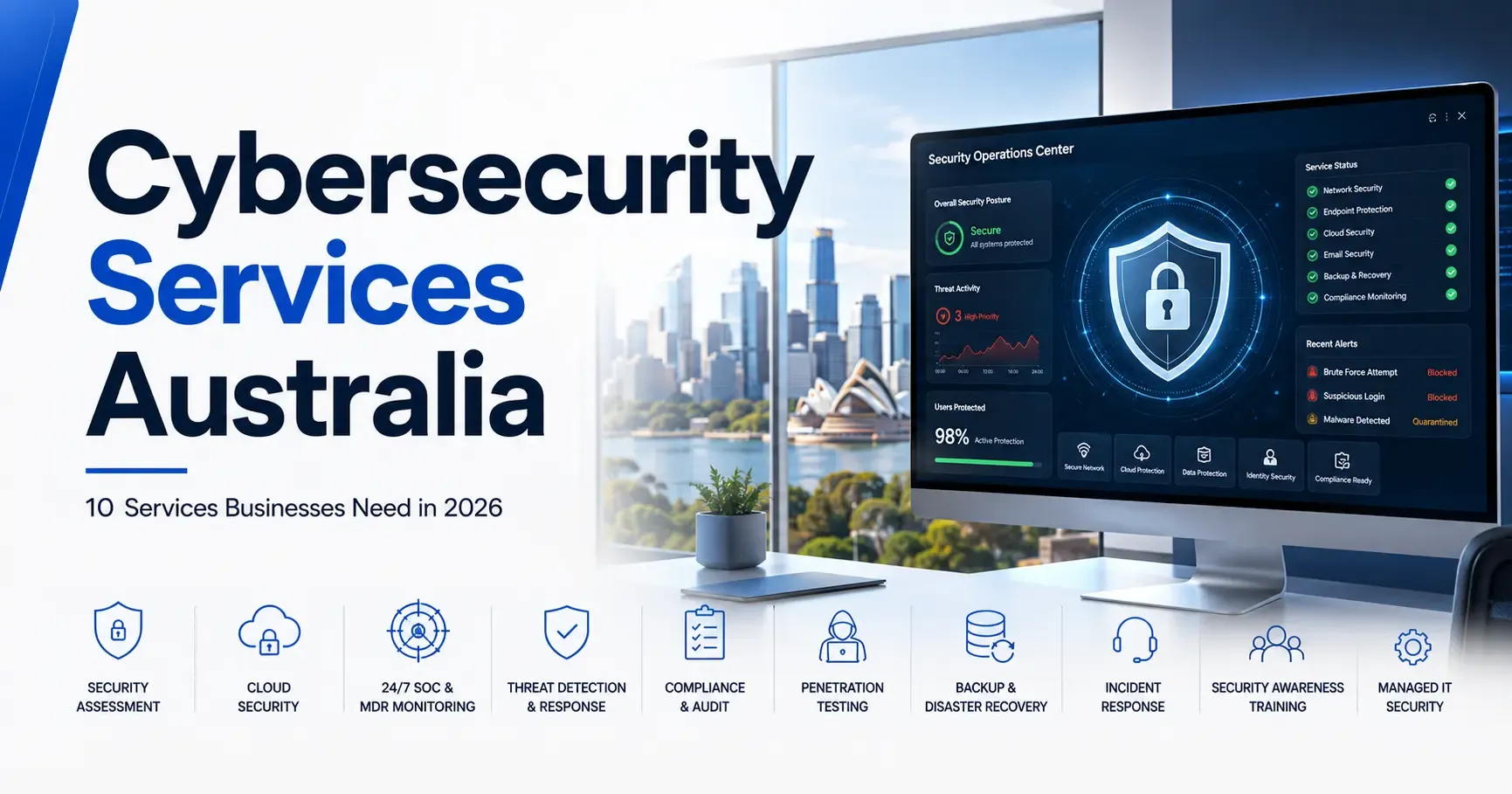
Australian businesses in 2026 need ten core cybersecurity services: a cyber risk assessment, compliance support, Essential Eight implementation, managed detection and response, cloud security, penetration testing, incident response planning, security awareness training, backup and disaster recovery, and virtual CISO services. Together, these protect your systems, data, and customers from the most common attacks. Cybersecurity is no longer just an IT problem. It's a business survival issue. With more cloud adoption, remote work, digital payments, and stricter compliance expectations, the risk has shifted from "if" to "when." This guide walks you through the real threats, the services that matter, penetration testing basics, compliance requirements, and what cybersecurity actually costs in Australia. Let's start with why this matters more than ever. Why Cybersecurity Is a Serious Priority for Australian Businesses in 2026 Cyberattacks against Australian businesses keep climbing. Attackers have gone professional, and they automate much of their work. That means even a small accounting firm or online store can be hit by the same tools used against large companies. Small and medium businesses (SMEs) are often easy targets. Many run on tight budgets, lean IT teams, and outdated tools. Attackers know this, so they look for the weakest door rather than the biggest prize. The damage from a single incident adds up fast: Downtime that stops sales, payroll, and operations Financial loss from ransom payments, fraud, or recovery costs Legal and compliance issues if customer data is exposed Customer trust damage that can take years to rebuild Data exposure of personal, financial, or healthcare records Antivirus software alone won't cut it anymore. Modern businesses need practical, layered cybersecurity services in Australia that cover prevention, monitoring, response, and recovery. Quick takeaway: Treat cybersecurity as a core business cost, not an optional IT extra. Cybersecurity Threats Facing Australian Businesses Knowing your enemy helps you spend wisely. Here are the threats hitting Australian businesses hardest right now. Ransomware Attacks Ransomware locks your files or entire systems, then demands payment to unlock them. A logistics firm might lose access to its dispatch software, or a clinic might lose patient records overnight. Even if you pay, there's no guarantee you'll get your data back. Strong ransomware protection plus tested backups is your best defence. Phishing and Business Email Compromise Phishing uses fake emails to trick staff into clicking bad links or handing over passwords. Business email compromise (BEC) goes further. Common examples include: Fake invoices asking you to "update" bank details Emails impersonating your CEO requesting an urgent transfer Login pages that steal staff credentials These scams cost Australian businesses millions each year, and they rely on human error rather than fancy hacking. Cloud Misconfiguration Most businesses now run on platforms like Microsoft 365, AWS, or Google Cloud. A single misconfigured setting can expose sensitive files to the public internet. Common mistakes include open cloud storage, weak access permissions, and SaaS tools shared too widely. A regular cloud security review catches these before attackers do. Data Breaches A data breach exposes information you're meant to protect, such as customer details, employee records, financial data, or confidential business files. Beyond the cleanup cost, you may face mandatory reporting and lost contracts. Good data protection controls reduce both the chance and the impact. Weak Passwords and Poor Access Control Reused or simple passwords are still one of the easiest ways in. So is giving every staff member admin access "just in case." Three controls make a big difference: Multi-factor authentication (MFA) on all key accounts Strong password policies backed by a password manager Regular user access reviews to remove old or excessive permissions Supply Chain and Third-Party Vendor Risk You can do everything right and still be hit through a supplier. If your software vendor, IT provider, or outsourced partner is breached, attackers can reach you too. This is why vendor risk management matters. Check the security of the partners who can access your systems or data. Quick takeaway: Most attacks exploit people, passwords, cloud settings, or trusted third parties—not exotic hacking. Fix the basics first. What Are Cybersecurity Services? Cybersecurity services are professional services that help your business protect its systems, networks, cloud platforms, applications, data, users, and daily operations from cyber threats. They usually cover six areas: Prevention – stopping attacks before they happen Monitoring – watching for suspicious activity around the clock Testing – finding weak spots through assessments and penetration testing Compliance – meeting legal and industry requirements Response – acting quickly when an incident occurs Recovery – restoring operations and data after an attack The best cyber security companies Australia-wide focus on your business risk, not just technical reports. A good provider explains what matters in plain language and helps you decide where to spend first. The 10 Cybersecurity Services Australian Businesses Actually Need in 2026 Here are the ten services that deliver the most protection for the money. 1. Cybersecurity Risk Assessment A cyber risk assessment finds the gaps in your defences before attackers do. It reviews your systems, networks, cloud tools, users, policies, and processes. The result is a clear, prioritised list of what to fix first. This is the smartest place to start because it stops you spending on tools you don't need. 2. Cybersecurity Compliance Services Cybersecurity compliance services help you meet security, privacy, customer, and industry requirements without the guesswork. They cover Essential Eight alignment, ISO 27001 readiness, audit preparation, policy creation, and security documentation. These services are especially important for healthcare, fintech, SaaS, ecommerce, logistics, and professional services—any business handling sensitive data or chasing enterprise contracts. 3. Essential Eight Implementation The Essential Eight is Australia's recommended cybersecurity baseline, designed by the Australian Cyber Security Centre. It includes practical controls like: Multi-factor authentication Regular patching of systems and applications Daily backups Application control Restricting administrator access Disabling risky macros Implementing these controls blocks a large share of common attacks and is often expected during compliance reviews. 4. Managed Detection and Response (MDR) MDR provides ongoing threat monitoring and rapid response, usually 24/7. It's ideal for businesses without a full internal security team. If something suspicious happens at 2am, MDR specialists spot it and act before it becomes a major breach. Think of it as a security team on call without the full salary cost. 5. Cloud Security Services Cloud security services protect platforms like AWS, Azure, Google Cloud, Microsoft 365, SaaS applications, cloud storage, and remote access environments. They typically cover: Access control Misconfiguration review Cloud monitoring Data protection If most of your business operations run in the cloud, cloud security services are essential for maintaining visibility, reducing risk, and protecting sensitive data. 6. Penetration Testing Penetration testing checks your systems the same way a real attacker would. It hunts for vulnerabilities in your websites, apps, APIs, cloud systems, and networks. The goal is simple: find and fix weaknesses before criminals exploit them. We cover this in detail below. 7. Incident Response Planning An incident response plan is your step-by-step playbook for when an attack happens. A solid plan covers: Who does what How you communicate internally and to customers Legal and reporting steps Technical containment and ransomware response Recovery to normal operations Having this ready turns chaos into a controlled process. 8. Security Awareness Training Most attacks start with a person clicking the wrong thing. Security awareness training teaches your team to spot phishing, scams, weak passwords, and unsafe data handling. It's one of the cheapest ways to cut your risk, because it reduces human-error attacks across the whole business. 9. Backup and Disaster Recovery Services Backups protect your business continuity after ransomware, hardware failure, or accidental deletion. Strong setups include: Secure backups Cloud backups Offline (air-gapped) backups Regular recovery testing A backup you've never tested is just a hope. Testing proves you can actually restore. 10. Virtual CISO Services A virtual CISO gives you expert cybersecurity leadership without hiring a full-time executive. They help with your security roadmap, budget, compliance, board reporting, and vendor risk. This is one of the most affordable cybersecurity services in Australia for growing companies that need strategy but can't justify a six-figure hire yet. Quick takeaway: Start with a risk assessment, then layer in MFA, backups, training, and monitoring as your budget allows. Penetration Testing Guide for Australian Businesses Penetration testing comes up a lot during compliance and enterprise deals. Here's what you need to know. What Is Penetration Testing? Penetration testing is a controlled, ethical security test used to find vulnerabilities before attackers do. A skilled tester safely attempts to break into your systems, then reports exactly what they found and how to fix it. It's like hiring someone to test your locks before a burglar does. Types of Penetration Testing Different parts of your business need different tests: Web application testing – checks your website and customer portals Mobile app testing – reviews iOS and Android apps for flaws API testing – examines the connections between your systems Network testing – probes your internal and external networks Cloud testing – reviews cloud platforms and configurations Wireless security testing – checks Wi-Fi and connected devices When Should a Business Get Penetration Testing? Good times to test include: Before launching a new website, app, or platform After major system changes Before a compliance audit After a cloud migration After a cyber incident At least once a year for high-risk businesses What Should a Penetration Testing Report Include? A useful report goes beyond a list of problems. Look for: A clear vulnerability list A risk rating for each finding The business impact in plain language Proof of concept showing the issue is real Practical fix recommendations A retesting option to confirm fixes worked Quick takeaway: A good pen test report should help your IT team act, not just tick a box. Managed Security Services vs In-House Cybersecurity Team Should you outsource security or build your own team? Here's a side-by-side view. Factor Managed Security Services In-House Security Team Cost Lower and predictable Higher salary and hiring cost Expertise Access to multiple specialists Depends on hired employees 24/7 Monitoring Usually available Expensive to maintain Scalability Easier to scale Slower to expand Control Shared with provider Full internal control Best For SMEs and growing businesses Large enterprises with complex needs For most SMEs, managed security services win on cost and expertise. You get specialists and round-the-clock threat monitoring without paying several full-time salaries. An in-house team makes sense for large enterprises with bigger budgets, complex environments, and strict control needs. Many businesses also use a hybrid model: a small internal team handles day-to-day work while a provider covers monitoring, testing, and specialist skills. Quick takeaway: If you don't have the budget for 24/7 in-house coverage, managed services are usually the smarter choice. Cybersecurity Compliance Requirements Australian Businesses Should Know Compliance simply means meeting the security rules and expectations that apply to your business. Those rules depend on your industry, the data you hold, and what your customers expect. Businesses handling personal data, healthcare data, payment data, or enterprise client data need stronger controls and clearer evidence. Key areas to plan for: Privacy and data protection – handling personal information responsibly Essential Eight alignment – Australia's baseline controls ISO 27001 readiness – a global security management standard often required by larger clients Security policies and documentation – written rules staff can follow Incident response planning – proof you can react to a breach Vendor risk management – checking your suppliers' security Customer security questionnaires – the forms enterprise clients send before signing Audit preparation – being ready to show your controls work Cybersecurity compliance services pull all of this together. They reduce your risk and prepare you for audits, enterprise contracts, and regulatory expectations, so a missed checklist item doesn't cost you a deal. Quick takeaway: Compliance readiness often unlocks bigger contracts, not just lower risk. Cybersecurity Cost Guide Australia There's no single price tag for cybersecurity. Cost depends on your needs and risk level. What Affects Cybersecurity Costs? Several factors shape your price: Number of employees Number of devices Number of applications Cloud setup and complexity Data sensitivity Compliance requirements Monitoring requirements Testing scope Incident response needs A 10-person consultancy with simple needs will pay far less than a fintech handling payment data across multiple cloud platforms. How Can Small Businesses Start Affordably? You don't need to buy everything at once. Affordable cybersecurity services in Australia let you build protection in stages. A sensible starting order: Cybersecurity risk assessment MFA setup Backup and recovery Patch management Security awareness training Cloud security review Compliance gap assessment This sequence covers the most common attacks first, at the lowest cost. What Should Businesses Avoid? Steer clear of these common mistakes: Buying tools without a strategy Choosing the cheapest provider on price alone Ignoring compliance Skipping backup testing Failing to monitor systems Treating cybersecurity as a one-time project Quick takeaway: Spend on a plan first, then tools. Strategy saves more money than discounts. How to Choose the Right Cyber Security Companies in Australia Not all providers are equal. Before you sign, check that a provider offers: Industry experience relevant to your business Strong compliance knowledge A clear, written service scope Practical, plain-language reporting Transparent pricing Genuine incident response capability Cloud security experience Penetration testing expertise Ongoing support, not just one-off projects The ability to work with both SMEs and enterprises The best cybersecurity companies Australia offers will talk about your business goals, not just technical jargon. If a provider can't explain what they'll do and why, keep looking. Quick takeaway: Choose a partner who reduces your risk and explains it clearly, not one who only sells products. Which Cybersecurity Services Should Your Business Prioritise First? Your industry shapes where to start. Here's a practical guide. Business Type Prioritise First Small Business Risk assessment, MFA, backup, awareness training, cloud security review Healthcare Compliance services, data protection, MDR, incident response, backup and recovery Ecommerce Penetration testing, payment security, cloud security, fraud prevention, backup SaaS API penetration testing, cloud security, compliance readiness, MDR, secure development review Logistics Endpoint security, access control, backup, incident response, vendor risk management For small businesses, the basics deliver the biggest wins. A risk assessment, MFA, backups, training, and a cloud review cover most everyday threats. For healthcare businesses, patient data and privacy come first. Compliance services, data protection, MDR, incident response, and tested backups protect both records and reputation. For e-commerce businesses, money and customer data are the targets. Penetration testing, payment security, cloud security, fraud prevention, and backups keep your store trading safely. For SaaS companies, your platform is the product. API penetration testing, cloud security, compliance readiness, MDR, and secure development reviews protect both your code and your clients. For logistics companies, uptime and connected systems matter most. Endpoint security, access control, backups, incident response, and vendor risk management keep operations moving. Final Thoughts Australian businesses in 2026 need practical, risk-based cybersecurity, not just software. The services that matter most are risk assessment, compliance, Essential Eight, managed detection and response, cloud security, penetration testing, incident response, awareness training, backup, and virtual CISO support. Don't wait for a cyberattack to act. The cheapest time to protect your business is before an incident, not during one. The right cybersecurity partner can help you protect data, reduce downtime, improve compliance, and build lasting customer trust. If your business is looking for reliable cybersecurity services in Australia, our experts can help you assess risks, improve compliance, secure cloud systems, and build a practical cybersecurity roadmap.























































































Start Build Your
Next Digital Solution?
Let’s build scalable, future-ready digital solutions tailored to your business goals. Connect with our experienced technology consultants to discuss your vision, strategy, and growth opportunities — with zero obligation and complete transparency.
Get a free consultation and cost estimate for your digital solution
Our expert will contact you within 24 hours. Check your email for confirmation.
Partner with SISGAIN experts to build secure, scalable AI-powered IT Solutions that transform your business operations.









DUQE FREEZONE Quarter Deck, Queen Elizabeth 2, Mina Rashid, Dubai, UAE

100 Consilium Pl Suite 200, Scarborough, ON M1H 3E3, Canada

C-109, Sector 2, Noida, Uttar Pradesh 201301 India
Project quotes, partnerships, implementation
Open roles, referrals, campus hiring