
 +1 844-445-5767
 +971 56-848-5757
 +91 921-208-0630
For Business & Service Inquiries
Sales Team
Project quotes, partnerships, implementation
Explore the real development cost, AI integrations, fintech architecture, compliance requirements, and monetization strategy behind AI budgeting apps like Cleo.
Consumers no longer want a static spreadsheet dressed up as an app. They want financial guidance that feels like a conversation — one that knows their spending habits, flags a risky purchase before they make it, and nudges them toward savings goals without sounding like a corporate disclaimer.
That shift is exactly why the Cleo budgeting app became a benchmark in the AI personal finance space. Cleo didn't just track expenses — it talked back, made jokes, called out bad spending decisions, and built a loyal user base in the millions. That kind of experience, powered by generative AI and conversational banking, is now what founders across the fintech landscape are trying to replicate and improve upon.
In 2026, AI-driven money management is no longer a differentiator — it's an expectation. Open banking mandates, Gen AI transformation in fintech, and a growing consumer appetite for hyper-personalized financial tools are fueling massive investment in this category. Whether you're a fintech startup building an MVP or an enterprise expanding your digital banking suite, the question isn't whether to build an AI finance app — it's how much it will cost to build one that actually works.
This guide breaks down every cost variable, tech decision, and compliance requirement you need to understand before your first sprint starts.
The Cleo budgeting app is an AI-powered financial assistant that connects to a user's bank accounts and credit cards, then uses machine learning and natural language processing to deliver personalized spending insights through a conversational interface.
Unlike traditional finance trackers — which display charts and wait for users to act — Cleo uses a cleo chatbot model to proactively engage users. It categorizes transactions automatically, identifies patterns in financial behavior, recommends savings amounts based on income and spending cycles, and sets budget limits that adapt over time.
The core distinction between an AI budgeting app and a traditional tracker is intelligence and interaction. Traditional apps are passive — you input data, they display it. AI budgeting apps are active — they analyze behavioral data, detect anomalies, and surface recommendations you didn't know you needed.
Key capabilities include:
For startups entering this space, Cleo sets the bar for what users now expect from any app claiming to be the best AI budgeting app on the market.
Several converging forces are pushing AI finance apps from niche product to mainstream infrastructure.
Open banking adoption has made it significantly easier for apps to access real-time transaction data with user consent, removing the friction that previously slowed fintech innovation. APIs from Plaid, Yodlee, and regional open banking frameworks now allow deep financial data access within compliant guardrails.
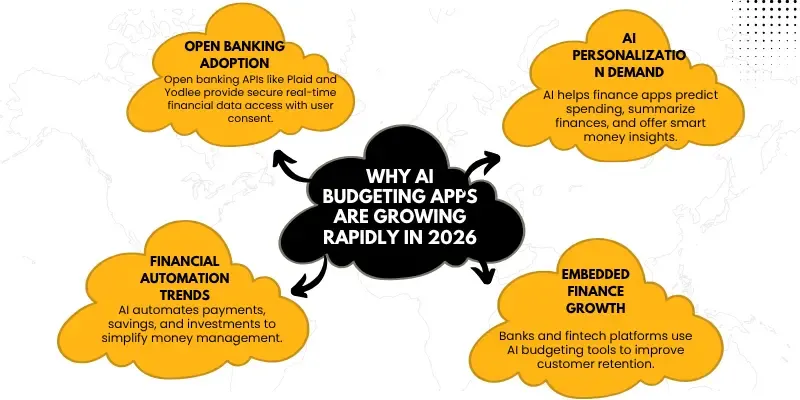
AI personalization demand has crossed into financial services. The same consumers who expect Netflix to know what they want to watch expect their finance app to know what they can afford to spend. Generative AI in banking is accelerating this — models can now generate plain-language financial summaries, predict cash flow shortfalls, and suggest corrective action in natural conversation.
Embedded finance growth means banks, neobanks, and even non-financial platforms are integrating AI budgeting layers into their core products. Digital banking competition is fierce, and AI-powered tools are now a retention mechanism, not just a feature.
Financial automation trends reflect a broader consumer desire to reduce the cognitive load of money management. Recurring payments, savings transfers, and investment contributions are increasingly being handled autonomously based on AI-set rules.
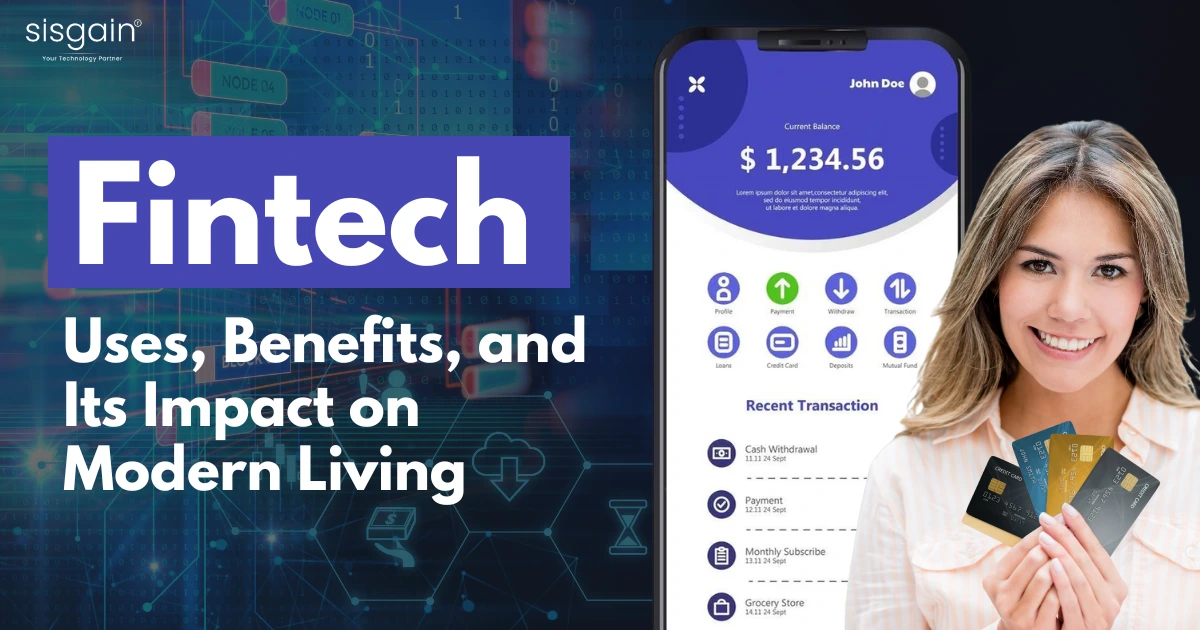
For a deeper look at how these macro shifts are shaping product strategy, the emerging FinTech Trends to Watch in 2026 reveal why AI finance applications are attracting disproportionate investment attention right now.
Getting the feature architecture right determines both product quality and development cost. Here's what an enterprise-grade AI budgeting app needs at its core.
The conversational layer is the product's identity. This is where AI Chatbot Development Services to Power Your Business Growth deliver the most visible ROI — users engage daily because the chatbot makes finance feel accessible. It provides spending insights, answers balance queries, and delivers smart financial responses in real time using NLP models.
A real-time analytics view that auto-categorizes transactions from connected accounts. Machine learning handles categorization accuracy, and users can override or customize categories without breaking the model.
AI-generated spending limits based on income patterns and financial goals. The engine recalibrates recommendations as user behavior evolves, moving beyond static budget templates.
Open banking APIs — including Plaid and Yodlee — enable transaction syncing across multiple institutions. This is a non-negotiable for any app positioned as a comprehensive financial hub.
Proactive alerts for bill due dates, overspending in specific categories, and unusual transaction patterns. The intelligence layer here separates a useful app from an annoying one.
Automatic detection of recurring charges, with actionable prompts to cancel subscriptions users no longer use. This single feature often generates the most immediate perceived value.
Integrated risk analysis and financial health scoring give users a complete picture of their financial standing — and give the app a stickiness that pure budgeting tools lack.
Beyond core functionality, these modules push apps from capable to exceptional — and push development budgets upward accordingly.
Using models like OpenAI, Gemini, or Claude to generate personalized budgeting narratives and AI-generated savings plans. Leveraging generative ai services for this layer requires prompt engineering, model fine-tuning, and ongoing output validation to maintain accuracy and compliance.
Spending prediction and cash-flow forecasting models trained on user transaction history. These require substantial ML infrastructure and data pipeline investment — but they're what separates tier-one AI finance apps from the rest.
Human-like chatbot responses with intent detection, entity recognition, and context retention across sessions. This is the backbone of any app competing with Cleo's conversational experience.
Risk scoring and transaction anomaly detection that operate in real time. Building this in-house requires significant ai and ml development services investment; using third-party APIs (like Sardine or Unit21) reduces cost but adds vendor dependency.
Voice-based budgeting assistants that let users check balances, set limits, or get financial summaries through natural speech. Adoption of this feature is growing rapidly among users who prioritize accessibility.
When these advanced modules are properly implemented, they form the foundation of Successful AI Solutions in the fintech space — products that retain users because they genuinely improve financial outcomes.
Here's a realistic component-level breakdown for building an AI budgeting app in 2026:
|
Development Component |
Estimated Cost |
|
UI/UX Design |
$5,000 – $15,000 |
|
Frontend Development |
$10,000 – $35,000 |
|
Backend Infrastructure |
$15,000 – $50,000 |
|
AI Model Integration |
$20,000 – $70,000 |
|
Banking API Integration |
$8,000 – $25,000 |
|
Security & Compliance |
$10,000 – $40,000 |
|
QA & Testing |
$5,000 – $15,000 |
|
Deployment & Maintenance |
$5,000 – $20,000 |
|
Total Estimated Range |
$78,000 – $270,000+ |

Custom AI models trained on proprietary financial data cost significantly more than API-based solutions using OpenAI or Gemini. For most startups, API-first AI is the right starting point — custom model development becomes viable at scale.
Apps built with Flutter — as seen in cross-platform projects like capita finance app Flutter Android — offer substantial cost savings over native iOS and Android development. A single codebase means roughly 40% reduction in frontend development time without meaningful performance trade-offs for most finance use cases. Flutter vs. native remains a genuine architectural decision: native wins on maximum performance and deep device integration; Flutter wins on speed, cost, and cross-platform reach.
Plaid and Yodlee both charge per connection and API call. Yodlee tends to be preferred by enterprise clients for its institutional-grade data aggregation, while Plaid offers broader developer accessibility. Open banking APIs in EU/UK markets add regional compliance complexity.
PCI DSS compliance is mandatory for apps handling payment data. GDPR applies to any app serving European users. KYC and AML requirements vary by financial product type — a savings recommendation feature has different regulatory exposure than a credit product. Each layer adds development time and third-party audit cost.
AWS and Azure dominate fintech deployments for their compliance certifications, security tooling, and geographic redundancy. Google Cloud is increasingly competitive for AI workloads. Real-time AI processing — especially for fraud detection and predictive analytics — requires auto-scaling infrastructure that adds to both build and operational cost.
The right stack balances fintech-grade performance, AI flexibility, and long-term scalability.
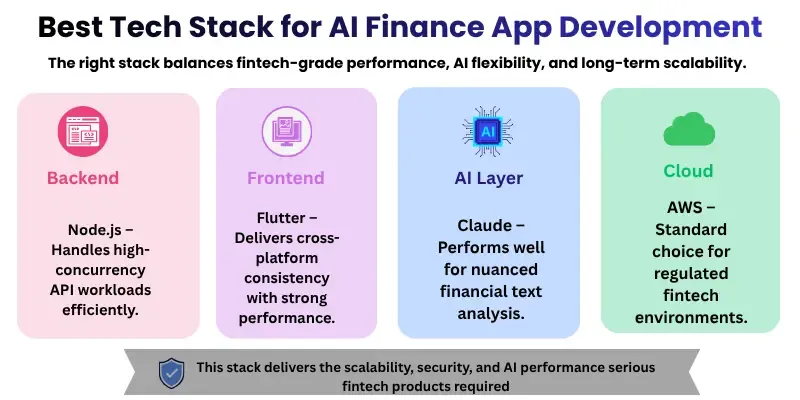
Backend: Node.js handles high-concurrency API workloads efficiently. Python with Django is the preferred choice when the application is AI-heavy, given Python's ML ecosystem depth.
Frontend: Flutter delivers cross-platform consistency with strong performance. React Native is a solid alternative with a larger developer pool. Experienced finance app developers will typically recommend Flutter for new fintech builds targeting both iOS and Android simultaneously.
AI Layer: OpenAI APIs, Gemini, and Claude each have distinct strengths. OpenAI leads on conversational quality and documentation depth. Gemini integrates tightly with Google Cloud infrastructure. Claude performs well on nuanced financial text analysis.
Database: PostgreSQL is the default for structured financial transaction data. MongoDB handles flexible schema requirements well for user preference data and AI model outputs.
Cloud: AWS remains the standard for regulated fintech environments. Google Cloud is increasingly chosen for AI-native architectures. Azure is preferred in enterprise contexts with existing Microsoft infrastructure.
This stack delivers the scalability, security, and AI performance that serious fintech products demand.
|
Development Stage |
Timeline |
|
Research & Planning |
2–3 Weeks |
|
UI/UX Design |
3–5 Weeks |
|
MVP Development |
3–4 Months |
|
AI Integration |
1–2 Months |
|
Testing & Security Audits |
3–5 Weeks |
|
Final Deployment |
1–2 Weeks |
|
Total (MVP) |
~6–8 Months |
A startup MVP — covering core budgeting, a basic AI chatbot, and one banking integration — can realistically reach market in six months with a focused team. An enterprise-grade platform with custom AI models, multi-region compliance, fraud detection, and voice features will run closer to 12–18 months end to end.
The line items above cover build costs. These are the operational expenses that routinely surprise first-time fintech founders:
The best AI budgeting app platforms are built around recurring revenue, not one-time downloads. Proven monetization models include:
Subscription Plans: Freemium access with paid tiers unlocking advanced AI insights, credit monitoring, or premium financial coaching. Cleo's own subscription model demonstrated strong conversion rates among engaged users.
Premium Financial Insights: Detailed spending analysis reports, annual financial health scores, and AI-generated savings strategies available as paid add-ons.
Affiliate Banking Products: Revenue-sharing arrangements with banks, credit card issuers, and lending platforms when users apply for financial products through the app.
AI Wealth Recommendations: Personalized investment suggestions tied to robo-advisory partnerships, generating both referral revenue and user lifetime value.
Sponsored Financial Services: Contextual placement of relevant financial products within the AI chat interface — executed responsibly within regulatory guidelines.
The economics of AI finance apps reward retention. Every feature decision should be evaluated against its impact on daily active usage and subscription renewal rates.
The category is evolving faster than almost any other area of consumer fintech. Within the next two to three years, expect:
As AI adoption accelerates across regulated industries, businesses are increasingly looking for custom AI model development providers for fintech and healthcare industries that can build secure, scalable, and compliance-ready solutions. While fintech organizations focus on fraud detection, financial forecasting, and conversational banking, healthcare providers leverage custom AI models for clinical decision support, predictive analytics, and patient engagement. The ability to develop industry-specific AI models has become a critical competitive advantage for organizations operating in data-intensive environments. For enterprises seeking tailored AI capabilities, our custom AI model development services provide end-to-end support, from data engineering and model training to deployment, optimization, and governance.
Fintech competition has intensified to the point where a standard mobile banking app is no longer a differentiator — it's a minimum viable product. Businesses are investing in AI finance apps because:
The window to build differentiated AI finance products is still open. But it's narrowing as incumbents accelerate their own AI programs.
Beyond fintech applications, SISGAIN helps organizations across healthcare, insurance, banking, and enterprise sectors develop custom AI models tailored to their specific business objectives. Companies looking for custom AI model development providers for fintech and healthcare industries choose experienced partners that can combine domain expertise, regulatory compliance, and advanced machine learning capabilities into scalable production systems.
Our capabilities include:
Whether you're building an MVP to validate market fit or a full-scale enterprise platform, we have the architecture, compliance knowledge, and AI depth to execute it properly.
Explore Our Software Application Development Services Now
Whether you want to create an MVP budgeting app or a fully scalable AI-powered finance platform like Cleo, our fintech experts can help you design, develop, and scale your solution securely.




Start Build Your
Next Digital Solution?
Let’s build scalable, future-ready digital solutions tailored to your business goals. Connect with our experienced technology consultants to discuss your vision, strategy, and growth opportunities — with zero obligation and complete transparency.
Get a free consultation and cost estimate for your digital solution
Our expert will contact you within 24 hours. Check your email for confirmation.
Partner with SISGAIN experts to build secure, scalable AI-powered IT Solutions that transform your business operations.









DUQE FREEZONE Quarter Deck, Queen Elizabeth 2, Mina Rashid, Dubai, UAE

100 Consilium Pl Suite 200, Scarborough, ON M1H 3E3, Canada

C-109, Sector 2, Noida, Uttar Pradesh 201301 India
Project quotes, partnerships, implementation
Open roles, referrals, campus hiring