
 +1 844-445-5767
 +971 56-848-5757
 +91 921-208-0630
For Business & Service Inquiries
Sales Team
Project quotes, partnerships, implementation
Every healthcare CIO and IT director eventually faces the same fork in the road: do you build your own cybersecurity team, or do you bring in a managed security services provider to do it for you?
On the surface, it seems like a simple build-vs-buy decision. But in reality, it is one of the most financially and operationally consequential choices your organization will make in 2025 and beyond.
Here is the part most vendors and analysts quietly skip over: the true cost of each option is almost never what it looks like on paper. The salary ranges, the licensing fees, the tool budgets — those are the visible numbers. The hidden costs — talent attrition, compliance gaps, breach response, 3 a.m. escalations with no one on shift — are where organizations bleed money without ever connecting the dots back to their security model.
This blog breaks down both options with real numbers, a healthcare-specific lens, and the kind of honest comparison that helps you make a decision your CFO and your compliance officer will both respect.
Before comparing costs, it is worth being precise about what you are actually comparing.
An in-house security team means your organization directly employs the analysts, engineers, and architects responsible for monitoring, detection, response, and compliance. You own the tools, you manage the talent, and you carry the full operational overhead. For 24/7 coverage — which any healthcare organization handling ePHI genuinely needs — that means multiple analysts working rotating shifts, a SOC manager, and a technology stack that ranges from SIEM platforms to endpoint detection tools.
A managed security services provider (MSSP), by contrast, delivers those same functions as a subscription. Your provider operates a shared or dedicated security operations center, employs the analysts, maintains the tools, and monitors your environment around the clock. You pay a predictable monthly or annual fee rather than carrying the payroll, benefits, training, and infrastructure costs internally.
Both can work. But the financial and operational reality of each is dramatically different — and for healthcare organizations operating under HIPAA, the compliance dimension adds another layer of complexity that tips the scales in ways most organizations do not fully anticipate.
Let us put real figures to what a functional in-house security operation actually requires for a mid-sized healthcare organization.
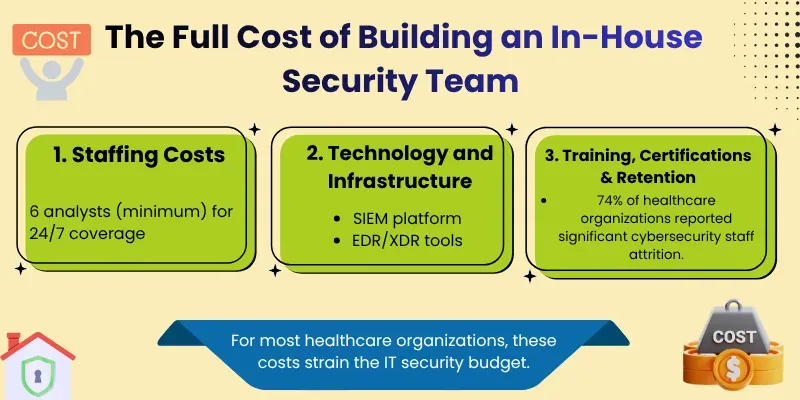
The U.S. Bureau of Labor Statistics reported the median annual salary for information security analysts at $124,910 in May 2024, with senior threat hunters and SOC leads pulling considerably higher. Running three analyst tiers plus a SOC manager across genuine 24/7 coverage requires a minimum of six analysts—eight is more realistic if you want sustainable shift rotations without burning people out. Six analysts at median costs of $749,460 per year before benefits, bonuses, or overtime.
Add benefits, employer taxes, and bonuses—typically 30–35% on top of base salary—and your personnel line alone approaches $1 million annually before you have hired a SOC manager, a CISO, or a compliance officer.
A functional SOC requires a SIEM platform, endpoint detection and response (EDR/XDR) tools, threat intelligence feeds, vulnerability management software, and network monitoring capabilities. Technology licensing and maintaining core security tools may add $300,000 to $1 million or more per year.
Cybersecurity certifications are not optional in a regulated environment. CISSP, CISM, CEH, and HIPAA-specific training are recurring costs. And even after investing in training, healthcare organizations are watching those investments walk out the door.
A Black Book Research survey found that 74% of healthcare organizations reported significant cybersecurity staff attrition over the past year. 90% of cybersecurity professionals exiting healthcare cited substantially higher compensation and reduced stress in technology and finance sectors.
Every time a trained analyst leaves, you absorb recruitment costs, onboarding time (typically 3–6 months before full productivity), and a coverage gap that creates real exposure.
Ponemon Institute research suggests the average annual cost of operating an in-house SOC can be around $2.84 million. Industry analyses broadly place the range for a fully functional in-house SOC at between $1 million and $4 million annually depending on organizational size.
For most healthcare organizations outside the largest enterprise health systems, that number represents an unsustainable portion of the IT security budget.
The pricing range for managed security services is wide because the scope of services varies significantly. Here is how the numbers break down across organization sizes.
On average, businesses can expect to pay between $3,000 and $30,000 per month for MSSP services. For organizations requiring advanced services such as extended detection and response (XDR) or ongoing compliance management, costs may be higher.
For healthcare-specific coverage that includes HIPAA compliance monitoring, incident response, and 24/7 SOC operations:
A genuine 24/7 in-house SOC costs $1.2 million to $2.5 million per year. SOC-as-a-Service covers the same ground for $60,000 to $300,000.
Organizations implementing outsourced SOC services reported saving an average of $2.22 million compared to maintaining internal security teams without automation capabilities.
The math is not subtle. For most healthcare organizations, the managed security services cost is 20–40% of what the equivalent in-house operation would run. But the cost comparison is only the beginning of the story.
This is the section most cost-comparison posts skip. The visible costs are easy to model. The hidden costs are where healthcare organizations consistently underestimate their exposure.
Ransomware does not operate on business hours. The majority of attacks are initiated outside of standard working hours precisely because most in-house teams are not fully staffed around the clock. If your team covers 8 a.m. to 6 p.m. Monday through Friday, you have roughly 128 hours per week of reduced coverage. An MSSP operating a 24/7 SOC closes that window entirely.
Over 80% of healthcare organizations polled admitted that cybersecurity investments are underutilized due to staffing shortages, wasting millions in technology spend. You can pay for a best-in-class SIEM platform, but if your analysts do not have the bandwidth or the expertise to tune it properly, you are paying for a fire alarm that only goes off when the building has already burned down.
When an in-house team cannot contain an incident quickly — often because of staff limitations or tool gaps — the escalation costs grow exponentially. Forensics firms, outside legal counsel, regulatory notification procedures, and breach remediation all compound rapidly.
Hospitals can lose up to $900,000 per day during downtime, when surgeries, prescriptions, and claims are disrupted. An incident that an MSSP's 24/7 team might detect and contain in two hours can turn into a 72-hour outage for an under-resourced in-house team — and that difference in detection time is the difference between a manageable incident and a catastrophic one.
The global cybersecurity workforce gap has hit a record 4.8 million unfilled roles — a 19% year-over-year increase. Organizations with significant security staff shortages face data breach costs that are, on average, $1.76 million higher than their well-staffed counterparts.
When your open roles stay open, your risk premium is not theoretical. It is measured in breach cost differentials.
The threat landscape evolves faster than most internal training budgets can keep pace with. AI-driven attacks, supply chain compromises, and emerging cyber threats require analysts who are constantly updated on new techniques and attack vectors. An MSSP's entire operating model is built around staying current because their reputation and client retention depend on it. An in-house team's training budget is often the first thing cut when IT costs come under scrutiny.
For healthcare organizations, cybersecurity is not just an IT concern — it is a legal and regulatory obligation that carries direct financial penalties.
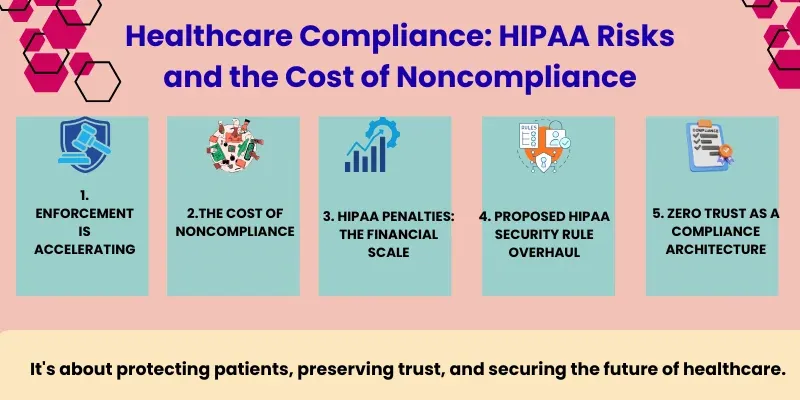
OCR investigates all breaches affecting 500 or more individuals and assesses whether they were due to noncompliance with the HIPAA Rules. There was a dip in HIPAA enforcement activity in 2023, but enforcement actions increased in 2024 and 2025, peaking in 2026 when 772 healthcare data breaches affecting 500 or more individuals were reported to OCR.
The enforcement pattern in recent years is clear: OCR is not just penalizing organizations for breaches. It is penalizing them for the absence of a documented, enterprise-wide security risk analysis — regardless of whether the breach itself was preventable.
A review of recent multi-million-dollar settlements reveals a consistent theme: OCR is penalizing organizations for the failure to conduct a thorough, enterprise-wide security risk analysis. This failure is cited as a core violation regardless of whether the breach itself was caused by ransomware, phishing, or an insider threat.
A robust managed cyber security services engagement typically includes ongoing risk analysis, documented remediation, and audit-ready compliance evidence — exactly what OCR expects to see when investigating a breach.
HIPAA civil penalties are tiered by culpability:
When a breach affects tens of thousands of patients — as the largest healthcare incidents do — these per-violation figures compound into multi-million-dollar settlements rapidly.
A proposed overhaul of the HIPAA Security Rule introduced by the Department of Health and Human Services is expected to mandate stringent cybersecurity standards, including multi-factor authentication, ePHI encryption, and rigorous annual compliance audits. Healthcare providers, already struggling with limited cybersecurity staffing, face enormous compliance pressures as the final rule awaits implementation.
For organizations relying on an in-house team that is already stretched thin, meeting these new requirements will likely require either significant investment in additional headcount and tooling — or a pivot to a managed services model that has compliance built into the service delivery framework.
Regulators and security frameworks increasingly point to zero trust security solutions as the architecture best suited to protecting ePHI in complex, interconnected healthcare environments. Zero trust assumes no user or device is inherently trusted, verifying continuously rather than relying on perimeter defenses. Implementing this architecture in-house requires specialized expertise that most healthcare organizations simply do not have on staff. MSSPs that specialize in healthcare can deploy and manage zero trust frameworks as part of the service engagement.
The following scenario is constructed from patterns documented across multiple real-world incidents reported by HIPAA Journal, IBM, and Netwrix.
A regional health system with approximately 1,200 employees maintained a six-person in-house IT security team. The team was competent but stretched across security, IT operations, and helpdesk functions simultaneously. They ran a basic SIEM tool and conducted quarterly vulnerability scans.
In early 2024, a phishing campaign targeting a business associate credential allowed threat actors to move laterally through the network for 23 days before detection. The attack encrypted patient scheduling systems and accessed approximately 340,000 patient records.
Total impact:
A post-incident review determined that the lateral movement would have been flagged within hours by a 24/7 SOC with behavioral analytics — standard in most MSSP service tiers. The cost of a mid-tier managed security engagement for that organization would have been approximately $180,000 per year.
The math: $12.6 million in incident costs vs. $180,000 in annual managed security investment.
|
Category |
In-House Team |
Managed Security Services |
|
Annual Cost (Mid-Size Healthcare) |
$1.2M – $2.8M |
$150,000 – $360,000 |
|
24/7 Coverage |
Requires 6–8 FTEs minimum; often not achieved |
Included as standard |
|
HIPAA Compliance Support |
Dependent on internal expertise |
Built into healthcare-focused MSSP engagements |
|
Threat Intelligence Access |
Limited to in-house feeds and vendor updates |
Shared intelligence across MSSP client base |
|
Incident Response Capability |
Limited by team size and availability |
Dedicated IR team on retainer |
|
Tool Maintenance |
Full burden on internal team |
Managed by MSSP |
|
Scalability |
Requires hiring (3–6 months lead time) |
Scales with contract scope |
|
Talent Attrition Risk |
High — especially in healthcare |
Low — absorbed by MSSP |
|
Regulatory Audit Readiness |
Variable |
Documented, audit-ready as standard |
|
Zero Trust Implementation |
Requires specialized hires |
Available as managed service |
|
Detection Speed (Avg) |
Hours to days |
Minutes to hours |
|
Breach Cost Liability |
Fully absorbed |
Shared/mitigated through faster detection |
The data tells a consistent story about where healthcare cybersecurity risk is concentrated and why the in-house model struggles to keep pace.
The average cost of a healthcare data breach in 2024 was $9.8 million. Breached healthcare information can be up to 50 times more valuable than financial information. Complete medical information can sell for up to $1,000 on dark web marketplaces.
Nearly half — 48% — of healthcare organizations experienced at least one cybersecurity incident over the past year. Healthcare breaches cost an average of $7.42 million per incident, the costliest of any industry.
The number of healthcare organizations reporting cyberattack losses exceeding $200,000 nearly quadrupled between 2024 and 2025. Attacks costing more than $500,000 occur twice as often in healthcare as in all other sectors.
Healthcare organizations experienced their costliest year on record, with total industry losses exceeding $21.9 billion from ransomware downtime alone — representing a 340% increase in financial impact compared to 2019 baseline measurements.
On the talent side:
In 2025, there are an estimated 3.5 million unfilled cybersecurity positions worldwide, with U.S. businesses struggling to fill about 500,000 security roles. 88% of organizations surveyed experienced at least one significant security incident in the past year due to skills shortages.
For healthcare organizations specifically, the workforce crisis is compounded by compensation competition from finance and technology sectors that can offer significantly higher salaries. An in-house model that depends on attracting and retaining talent is operating against structural headwinds that are not improving.
Organizations in regulated markets, including those seeking cybersecurity services Australia, face an additional compliance layer from frameworks like the Australian Privacy Act and the Notifiable Data Breaches scheme — both of which parallel HIPAA in their expectation of documented risk management and timely breach notification. The talent and compliance pressures apply globally, and managed services designed around regulatory compliance address them regardless of jurisdiction.
The right answer depends on your organization's size, existing infrastructure, compliance maturity, and risk tolerance. Here is a practical framework for deciding.
In most cases, the honest answer for mid-sized healthcare organizations is a hybrid model: a lean internal team focused on governance, vendor management, and strategic oversight, supported by a managed security provider that delivers 24/7 monitoring, incident response, and compliance documentation.
SISGAIN delivers managed cybersecurity services purpose-built for healthcare organizations navigating HIPAA compliance, expanding digital infrastructure, and an increasingly hostile threat environment.
Our healthcare security practice covers:
We work with health systems, specialty practices, medical device manufacturers, and digital health companies across North America and globally. Our team brings direct HIPAA, HITRUST, and SOC 2 experience, not generic IT security applied to a healthcare context.
If you are currently evaluating the managed security services cost against the fully-loaded cost of your in-house model — including the hidden costs documented in this article — we are happy to run that analysis with you in a no-obligation consultation.
The debate between managed security services and an in-house team is often framed as a question of control. In reality, for most healthcare organizations, it is a question of whether the control you think you have is actually delivering the protection you need.
For many small to mid-sized organizations, a single IT hire costs more than an entire managed service provider team and delivers less protection, coverage, and ROI. Control can be an illusion.
The data on healthcare breach costs, talent shortages, compliance penalties, and detection speed gap points in one direction: for healthcare organizations without the budget and infrastructure of a major enterprise health system, managed security services deliver materially better security outcomes at a fraction of the cost.
The hidden costs are not hidden once you look for them. Breach remediation, HIPAA settlements, operational downtime, and the compounding cost of talent attrition make the in-house model's true price tag far higher than the salary budget line suggests.
The question is not whether you can afford managed security services. It is whether you can afford not to have them.




Start Build Your
Next Digital Solution?
Let’s build scalable, future-ready digital solutions tailored to your business goals. Connect with our experienced technology consultants to discuss your vision, strategy, and growth opportunities — with zero obligation and complete transparency.
Get a free consultation and cost estimate for your digital solution
Our expert will contact you within 24 hours. Check your email for confirmation.
Partner with SISGAIN experts to build secure, scalable AI-powered IT Solutions that transform your business operations.









DUQE FREEZONE Quarter Deck, Queen Elizabeth 2, Mina Rashid, Dubai, UAE

100 Consilium Pl Suite 200, Scarborough, ON M1H 3E3, Canada

C-109, Sector 2, Noida, Uttar Pradesh 201301 India
Project quotes, partnerships, implementation
Open roles, referrals, campus hiring