
 +1 844-445-5767
 +971 56-848-5757
 +91 921-208-0630
For Business & Service Inquiries
Sales Team
Project quotes, partnerships, implementation

Cyber risk has become a board-level concern for Australian businesses, and 2026 is no exception. Ransomware crews now target small and mid-sized companies, not just enterprises. Cloud misconfigurations expose sensitive data overnight. Web application vulnerabilities give attackers a quiet way in. On top of that, compliance pressure keeps rising, and customers expect their personal information to stay protected.
This is where penetration testing earns its place. A cyber security penetration test shows you exactly how an attacker could break into your systems, before a real one does. It moves you from guessing about your security to knowing where you stand.
Understanding the wider landscape of cybersecurity threats for Australian businesses helps put penetration testing in context, because testing is most useful when it targets the risks that matter most to your organisation.
This guide explains what penetration testing is, the types available, how the process works, what it costs, and how to choose the right provider.
Penetration testing is a controlled security assessment where skilled ethical hackers try to break into your systems using the same techniques real attackers use. They test applications, networks, cloud systems, APIs, devices, and infrastructure to find exploitable weaknesses, then report them so you can fix the gaps.
Think of it as a planned, authorised attack carried out by people on your side. Nothing is destroyed and no data is stolen. Instead, the testers prove what an attacker could realistically achieve and document the path they took.
The result is clear, practical evidence of your security posture rather than a theoretical checklist.
The penetration testing purpose goes well beyond ticking a box. A good test helps you:
In short, it turns vague security worries into specific, fixable actions.
The threat environment facing Australian organisations keeps shifting. Several pressures make testing more important than ever.
Ransomware remains a leading cause of business disruption, and attackers now encrypt data and threaten to leak it. Phishing continues to trick staff into handing over credentials. Remote and hybrid work has widened the attack surface, with more devices and home networks connecting to company systems.
Cloud misconfiguration is one of the most common causes of data exposure, often through open storage buckets or weak identity settings. Third-party vendors introduce risk you do not fully control. AI-assisted attacks now help criminals write convincing phishing emails and scan for weaknesses faster.
Data breaches carry real financial and reputational costs, and compliance expectations continue to tighten. For many organisations, comprehensive penetration testing is now a core part of the cybersecurity services Australian businesses need to stay protected and audit-ready.
Different systems need different tests. Most organisations benefit from a mix depending on what they run.
Network testing examines both external and internal networks. External testing focuses on what an attacker sees from the internet, such as exposed services, open ports, and public-facing servers. Internal testing simulates an attacker who already has a foothold inside.
Testers review firewalls, VPNs, server configurations, and network segmentation to see how easily an intruder could move between systems.
Web application testing targets your websites, customer portals, admin dashboards, and login systems. Testers look at forms, session handling, authentication, payment flows, and business logic flaws.
For example, a tester might check whether one customer can view another customer's invoices by changing a value in the URL. That kind of business logic flaw rarely shows up in automated scans.
Mobile testing covers Android and iOS apps along with the APIs behind them. Testers examine authentication, how data is stored on the device, transport security, and app permissions.
The goal is to confirm that sensitive data stays protected even if the phone is lost or the app is reverse engineered.
Cloud testing focuses on AWS, Azure, and Google Cloud environments, where testers review IAM permissions, storage buckets, databases, cloud workloads, access controls, and common misconfigurations. For businesses running critical systems in the cloud, this should be supported by professional cloud security services to reduce exposure across cloud infrastructure.
Since cloud breaches often happen because of overly broad permissions, exposed assets, or weak configurations rather than software bugs alone, cloud penetration testing is an important part of a wider cybersecurity services strategy for any business running workloads in the cloud.
API Penetration Testing
APIs power SaaS platforms, mobile apps, fintech services, healthcare systems, logistics tools, and eCommerce sites. They often handle sensitive data and connect multiple systems.
API testing checks authentication, authorisation, rate limiting, input validation, and data exposure to make sure connected platforms stay secure.
Penetration testing infrastructure looks at the full technical environment that supports your business. This includes servers, endpoints, routers, databases, firewalls, VPNs, identity systems, cloud environments, and internal systems.
The aim is to understand how all these parts connect and where an attacker could pivot from one weak point to reach critical data.
The stages of penetration testing follow a structured lifecycle. This keeps the work safe, repeatable, and focused on business risk.
Testing starts with clear goals. You agree on which assets to test, the testing windows, the level of access provided, and the rules of engagement. Written approval is obtained before any testing begins.
This stage prevents surprises and keeps the test aligned with business priorities.
Testers collect information about your domains, IP addresses, technologies, exposed services, software versions, and public attack surfaces. They map what is visible to an outsider.
The more attackers can learn, the easier their job becomes, so this stage mirrors how a real campaign would start.
Here testers combine automated scanning with manual analysis, configuration review, and hands-on application testing. They identify weaknesses across systems and confirm which ones look genuinely exploitable.
Manual work matters because automated tools miss logic flaws and chained issues.
Testers safely exploit confirmed vulnerabilities to prove real-world impact. They show what an attacker could actually achieve without damaging systems or disrupting operations.
This separates theoretical risk from proven risk.
Once inside, testers assess how far the access could spread. They examine privilege escalation, lateral movement, accessible data, and the overall business impact of a successful breach.
This stage answers the question every leader asks: how bad could it get?
The findings are documented in a clear report. It includes an executive summary, technical findings, screenshots, severity ratings, affected assets, business impact, and remediation advice.
Good reporting helps both technical teams and decision-makers act quickly.
Your team fixes the issues, then testers retest to confirm each problem is resolved. Retesting closes the loop and gives you evidence that the risk is genuinely reduced.
The steps of a penetration test work well as a practical checklist:
Following these steps keeps testing organised and ensures nothing important is skipped.
A penetration testing process diagram helps business and IT teams understand the testing flow at a glance. It shows how each stage connects to the next, from planning right through to confirming fixes.
Scope → Reconnaissance → Vulnerability Discovery → Exploitation → Risk Analysis → Reporting → Remediation → Retesting
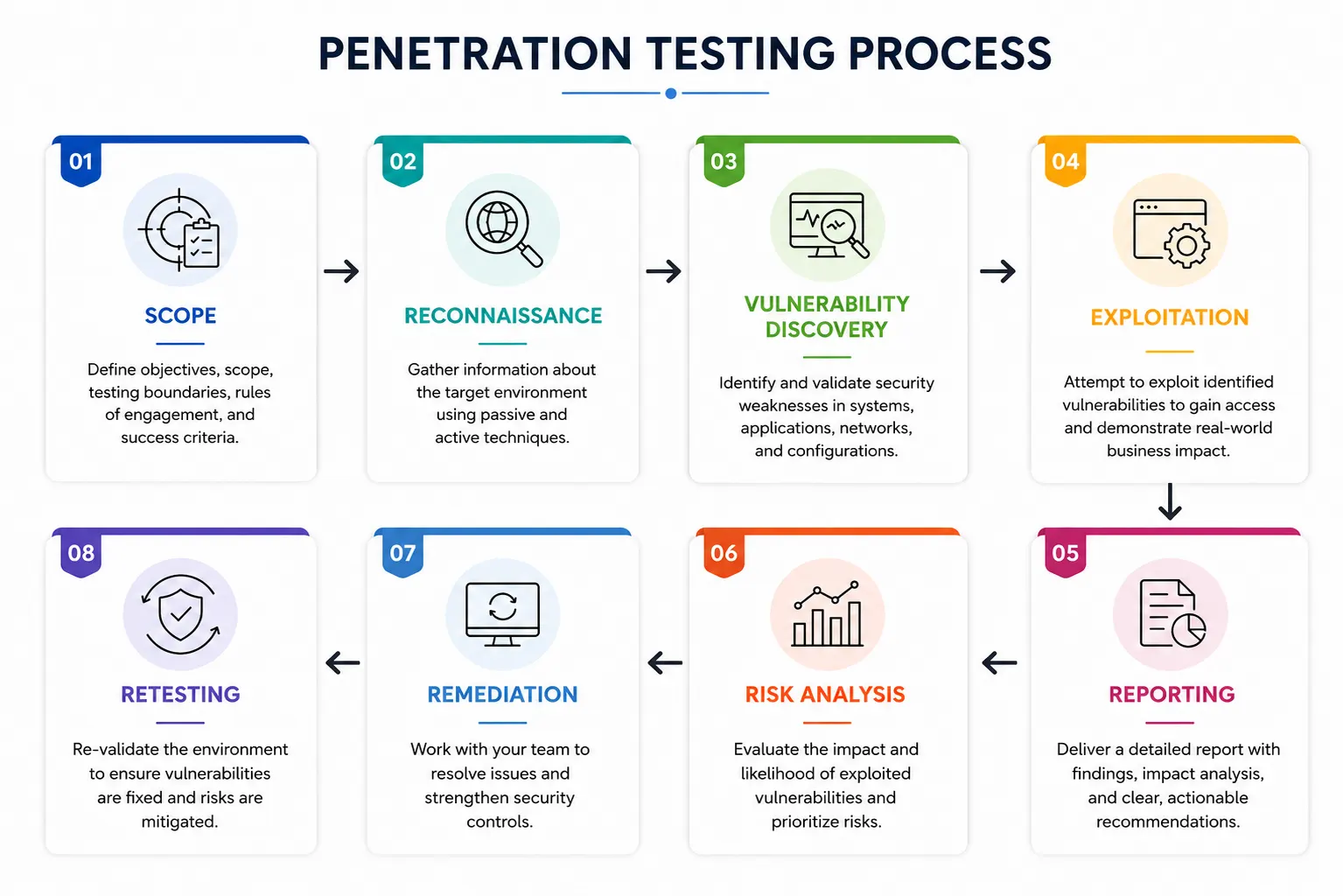
A test plan sets clear boundaries and expectations before any work begins. It protects both your business and the testers, and it makes sure the engagement targets the right systems with the right level of care.
Here is a simple penetration test plan example you can adapt:
|
Plan Area |
Example Details |
|---|---|
|
Business Objective |
Identify exploitable weaknesses before attackers do |
|
Scope |
Website, API, cloud server, internal network, or mobile app |
|
Test Type |
Black-box, grey-box, or white-box testing |
|
Testing Window |
After business hours or approved testing period |
|
Access Level |
No access, limited access, or admin-level test account |
|
Rules of Engagement |
No data deletion, no service disruption, no phishing unless approved |
|
Reporting |
Executive summary, technical findings, risk rating, remediation steps |
|
Retesting |
Validate fixes after remediation |
Many businesses ask how long does a penetration test take, and the honest answer is that it depends. Timing is shaped by scope, the number of assets, application complexity, the access level provided, reporting depth, and whether retesting is included.
A small, focused test wraps up quickly. A large environment with multiple systems takes longer because each area needs careful manual work.
|
Test Type |
Typical Duration |
|---|---|
|
Small website or app test |
3 to 5 business days |
|
Medium web app or API test |
1 to 2 weeks |
|
Network penetration test |
1 to 3 weeks |
|
Cloud infrastructure test |
1 to 3 weeks |
|
Comprehensive penetration testing |
2 to 6+ weeks |
A strong report is where the value of testing becomes clear. It should include:
The best reports speak to two audiences at once: executives who need the bottom line, and technical staff who need exact steps to fix problems.
These two services are often confused, but they serve different goals. A vulnerability assessment finds and lists known weaknesses across many systems. A cyber security penetration test goes further by validating which weaknesses can actually be exploited and what damage they could cause.
|
Area |
Vulnerability Assessment |
Penetration Testing |
|---|---|---|
|
Purpose |
Find known vulnerabilities |
Validate real-world exploitability |
|
Depth |
Broad but usually lighter |
Deeper and more manual |
|
Output |
List of potential issues |
Risk-based attack path analysis |
|
Best For |
Regular scanning |
High-risk systems and compliance |
|
Business Value |
Visibility |
Proof of real security risk |
Most mature security programs use both. Regular scanning keeps an eye on the basics, while periodic testing proves how resilient you really are.
The amount of information you give testers shapes how the test runs.
In black-box testing, the tester has little or no internal knowledge of your systems. They start from the outside, just like an external attacker. This shows what someone with no inside access could achieve.
In grey-box testing, the tester has limited access or information, such as a standard user account or partial documentation. This is often the most practical option for business testing because it reflects a realistic attacker who has gained some access, and it uses time efficiently.
In white-box testing, the tester has full access to source code, architecture diagrams, credentials, and documentation. This allows the deepest possible review and is well suited to high-risk applications and detailed code-level analysis.
Penetration testing supports audit readiness and helps demonstrate that your business takes security seriously. It also strengthens your wider IT risk and compliance program by identifying exploitable weaknesses before they become audit findings, data breaches, or operational risks. Many frameworks and obligations expect regular security testing, including ISO 27001, SOC 2, PCI DSS, the Essential Eight, and APRA CPS 234 for regulated financial entities.
Testing also helps you meet Privacy Act expectations around protecting personal information, satisfies vendor security reviews from enterprise clients, and supports cyber insurance requirements that increasingly ask for evidence of testing.
Understanding the cybersecurity compliance requirements in Australia that apply to your industry helps you plan testing that satisfies auditors and reduces risk at the same time.
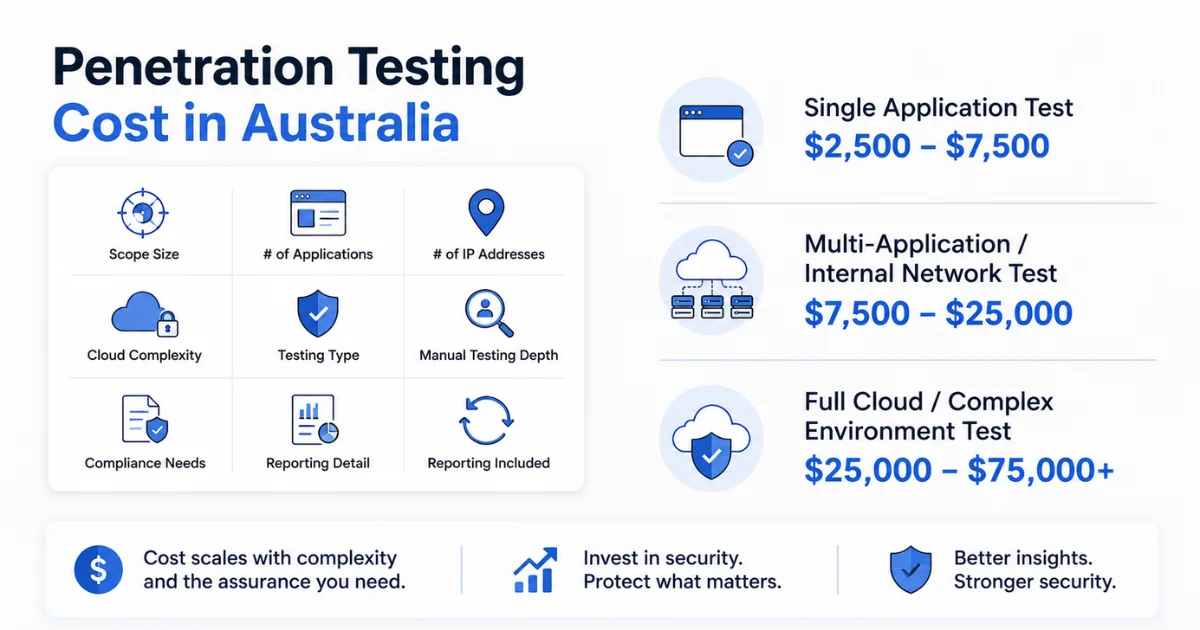
Pricing varies based on what needs testing. Key factors include scope size, the number of applications, the number of IP addresses, cloud complexity, the testing type chosen, the depth of manual testing, compliance requirements, reporting detail, and whether retesting is included.
A small single-application test costs far less than testing an entire cloud environment with multiple connected systems. As a rough guide, expect investment to scale with complexity and the level of assurance you need.
Because pricing deserves a closer look, a dedicated penetration testing cost Australia breakdown and a wider cybersecurity cost guide Australia will help you budget accurately for both testing and your overall security program.
One-time testing makes sense for a specific milestone, such as a product launch, a compliance audit, or a contract requirement. It gives you a snapshot of your security at that moment.
Ongoing testing suits businesses that change frequently. Consider annual testing as a baseline, quarterly testing for higher-risk systems, and additional tests after major releases, cloud migration, security incidents, and before audits.
Your decision often ties into a wider conversation about managed security services vs in-house team, since ongoing testing works best when paired with continuous monitoring and clear ownership of fixes.
Even well-meaning organisations make avoidable errors with IT penetration testing. Watch out for these:
Avoiding these mistakes turns testing from a cost into a genuine improvement in security.
The right provider makes a clear difference to the value you get. Before you commit, check for:
A provider capable of comprehensive penetration testing across all your systems gives you a complete picture rather than a fragmented one.
Good timing maximises value. Consider testing:
Building these triggers into your planning keeps security aligned with how your business actually changes.
If your business manages customer data, runs cloud systems, operates web or mobile applications, or needs to meet compliance requirements, penetration testing can help you find real security gaps before attackers do.
A professional penetration testing provider can assess your applications, APIs, cloud environment, network, and infrastructure, then give your team a clear action plan to reduce risk.
Penetration testing gives Australian businesses something rare in security: clear, evidence-based proof of where they stand. In 2026, with ransomware, cloud risk, and compliance pressure all rising, that clarity is worth a great deal.
Testing works best as one part of a broader Australian business cybersecurity strategy that also includes compliance, monitoring, incident response, awareness training, and ongoing risk management. No single test makes you secure on its own, but regular testing keeps your defences honest.
As you build out the cybersecurity services Australian businesses need, treat penetration testing as a recurring practice rather than a one-off task, and pair it with strong day-to-day cybersecurity services Australia providers can support over time.











Start Build Your
Next Digital Solution?
Let’s build scalable, future-ready digital solutions tailored to your business goals. Connect with our experienced technology consultants to discuss your vision, strategy, and growth opportunities — with zero obligation and complete transparency.
Get a free consultation and cost estimate for your digital solution
Our expert will contact you within 24 hours. Check your email for confirmation.
Partner with SISGAIN experts to build secure, scalable AI-powered IT Solutions that transform your business operations.









DUQE FREEZONE Quarter Deck, Queen Elizabeth 2, Mina Rashid, Dubai, UAE

100 Consilium Pl Suite 200, Scarborough, ON M1H 3E3, Canada

C-109, Sector 2, Noida, Uttar Pradesh 201301 India
Project quotes, partnerships, implementation
Open roles, referrals, campus hiring