
 +1 844-445-5767
 +971 56-848-5757
 +91 921-208-0630
For Business & Service Inquiries
Sales Team
Project quotes, partnerships, implementation
Enterprise content teams are facing a reality that’s hard to ignore: the demand for content has grown faster than any team can realistically handle. Brands are expected to publish across multiple channels, maintain consistency in messaging, personalize communication for different audiences, and now—optimize content not just for search engines, but for AI-driven platforms as well.
The problem is not a lack of ideas. It’s execution at scale.
Traditional content workflows rely heavily on manual processes—brief creation, writing, editing, approvals, publishing, and optimization. Each step introduces delays, inconsistencies, and rising costs. As content volume increases, so does the complexity. Teams either expand headcount or compromise on quality. In most cases, both happen.
This is where the shift begins.
Businesses are no longer asking, “How do we create more content?”
They are asking, “How do we build systems that create content for us—consistently, intelligently, and at scale?”
Automated content and copywriting powered by AI is no longer a trend—it’s becoming a core business capability. Modern enterprises are moving toward AI-driven content ecosystems where ideation, creation, optimization, and distribution are interconnected and largely automated.
At the same time, the discovery landscape is changing rapidly. Content is no longer consumed only through traditional search engines. AI platforms like ChatGPT and Perplexity are becoming primary sources of information, recommendations, and decision-making. This means your content must not only rank—it must also be understood, cited, and surfaced by AI models.
In this new environment, scalability is not optional. It is a competitive advantage.
Organizations that are investing in structured, AI-powered content systems are seeing measurable gains in efficiency, consistency, and visibility. But achieving this level of automation requires more than off-the-shelf tools. It requires a strategic approach, often supported by tailored Generative AI development services that align with business goals, workflows, and brand identity.
The future of content is not just automated—it is intelligent, adaptive, and deeply integrated into how businesses operate.
Automated content and copywriting in 2026 refers to the use of advanced artificial intelligence systems to create, optimize, and manage content with minimal human intervention. This includes everything from blog articles and website copy to product descriptions, email campaigns, ad creatives, and even multi-channel marketing assets.
At its core, automation is no longer about generating text—it’s about building end-to-end content systems that can think, learn, and adapt based on data, performance, and user intent.
Modern AI systems are capable of producing:
What makes this powerful is not just speed, but consistency. AI can maintain tone, structure, and messaging across thousands of content pieces—something that is difficult to achieve manually.
Behind this transformation are technologies like Natural Language Processing (NLP) and Large Language Models (LLMs). These systems are trained on vast datasets and can understand context, intent, and language patterns at a level that closely resembles human writing.
NLP enables machines to interpret and generate human language, while LLMs bring the ability to create coherent, context-aware, and structured content at scale.
For businesses looking to implement this effectively, investing in advanced NLP & Language AI Development solutions becomes essential. These solutions allow organizations to move beyond generic outputs and build systems that reflect their unique brand voice and domain expertise.
There is a significant difference between using AI tools and building an automated content system.
Basic AI Tools:
Enterprise AI Content Systems:
In simple terms, tools help you create content faster.
Systems help you build a sustainable content engine.
As businesses mature in their AI adoption, the shift from tools to systems becomes inevitable. Automated content and copywriting in 2026 is not about replacing writers—it’s about empowering organizations to operate at a level of scale and efficiency that was previously impossible.
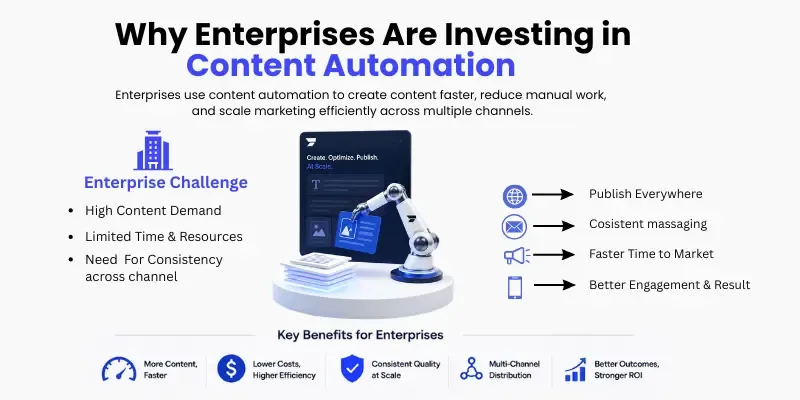
The shift toward automated content and copywriting is not driven by hype—it is driven by measurable business outcomes. Enterprises are under constant pressure to produce more content, faster, across more channels, while maintaining quality and consistency. Traditional models simply cannot keep up with this demand without escalating costs and operational complexity.
This is why content automation is becoming a strategic investment rather than an experimental initiative.
One of the most immediate benefits enterprises experience is the ability to scale content production 3–5x faster without proportionally increasing team size. AI-powered systems can generate drafts, repurpose existing content, and adapt messaging for different platforms in a fraction of the time it takes manual teams.
Instead of hiring additional writers, editors, and coordinators, organizations are building automated pipelines that handle repetitive and time-consuming tasks. This allows human teams to focus on strategy, creativity, and high-impact decision-making.
Content production at scale is expensive. When you factor in salaries, agency costs, revisions, and delays, the total investment becomes substantial.
With automation, enterprises are reporting cost reductions of 40–70% across content operations. This is achieved through:
More importantly, cost savings are not coming at the expense of quality. In many cases, quality improves due to standardized processes and data-driven optimization.
As organizations grow, maintaining a consistent brand voice across all content becomes increasingly difficult. Different teams, regions, and contributors often introduce variations in tone, messaging, and terminology.
Automated content systems address this challenge by embedding brand guidelines directly into AI models. This ensures that every piece of content—regardless of volume or channel—aligns with the organization’s voice and positioning.
Consistency is not just a branding advantage; it directly impacts trust, recognition, and conversion rates.
Content automation is part of a broader transformation in how businesses are adopting artificial intelligence. Enterprises are no longer experimenting with isolated AI tools—they are integrating AI into core business functions, including marketing, operations, and customer engagement.
This shift is reflected in emerging AI trends, where organizations are prioritizing:
Content is one of the first areas where these investments deliver visible ROI, making it a priority for leadership teams.
Initially, content automation was seen as a way to improve efficiency. Today, it is becoming a competitive differentiator.
Companies that adopt automation early are able to:
In a landscape where visibility directly impacts revenue, the ability to operate at scale is no longer optional—it defines market leaders.
Choosing the right automated content platform is not just about features—it’s about selecting a system that aligns with your business goals, workflows, and long-term scalability requirements. Decision-makers need to evaluate platforms beyond surface-level capabilities and focus on what truly drives performance and efficiency at scale.
At the core of any platform is its ability to generate high-quality content. This goes beyond grammatical correctness. Enterprise-grade systems should be able to:
Low-quality output leads to excessive editing, defeating the purpose of automation. High-quality generation, on the other hand, accelerates production while maintaining standards.
Generic content is one of the biggest limitations of basic AI tools. Enterprises require platforms that can learn and replicate their unique brand voice.
Look for systems that offer:
This capability ensures that automation enhances brand identity rather than diluting it.
Content creation is not a single task—it is a process involving multiple stages and stakeholders. Effective platforms should automate and streamline:
Advanced systems go a step further by orchestrating these workflows automatically, reducing manual intervention and improving turnaround times.
A critical but often overlooked feature is optimization for AI-driven search environments. Traditional SEO is no longer sufficient. Content must be structured and optimized in a way that AI models can easily interpret, summarize, and cite.
Platforms that support Generative Engine Optimization (GEO) help ensure that your content:
This capability is becoming essential as AI platforms influence how users discover and evaluate information.
Automation delivers maximum value when it integrates seamlessly with your existing systems. Look for platforms that connect with:
Seamless integration eliminates manual handoffs, reduces errors, and ensures that content flows efficiently from creation to publication and measurement.
Beyond features, decision-makers must consider whether a platform can handle enterprise demands. This includes:
A platform that works for a small team may not meet the requirements of a global enterprise. The right choice is one that grows with your organization and supports long-term strategy.
The market for automated content and copywriting platforms has matured significantly. What started as simple AI writing assistants has evolved into complex ecosystems that combine content generation, workflow automation, governance, and performance optimization.
Below is a carefully evaluated list of the top platforms in 2026, based on enterprise usability, scalability, AI capability, and real-world application.
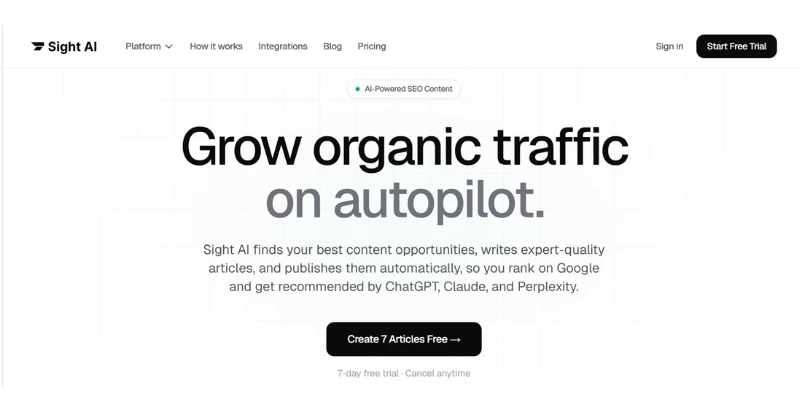
Best for: AI search optimization and automated content ecosystems
Sight AI stands out by focusing not just on content creation, but on how content performs in AI-driven environments. As platforms like ChatGPT and Perplexity influence discovery, Sight AI helps businesses understand and optimize their presence in these ecosystems.
Ideal for enterprises that want to bridge the gap between content creation and AI discoverability, especially in competitive industries where being referenced by AI platforms impacts decision-making.
While Sight AI introduces a forward-thinking approach to AI visibility, organizations may require time to fully understand and integrate this new layer of optimization into existing workflows.
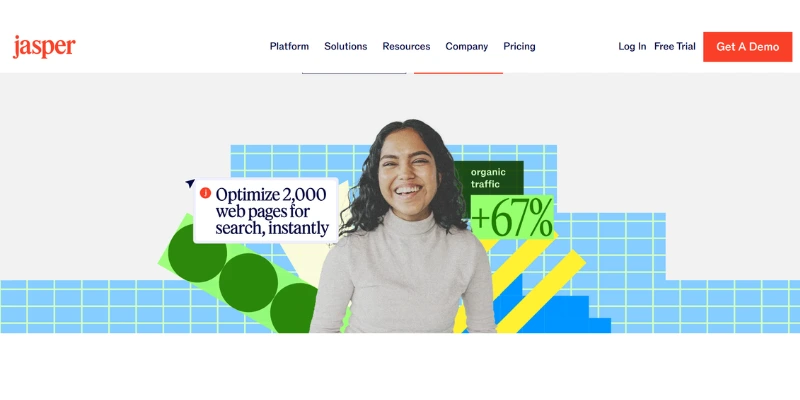
Best for: Maintaining consistent brand voice at scale
Jasper has established itself as a strong player in AI content generation, particularly for organizations that prioritize brand consistency across large volumes of content.
Best suited for marketing teams managing multi-channel campaigns where tone and messaging consistency are critical.
Best for: Regulated industries and compliance-driven content
Writer is designed for organizations where content accuracy and compliance are non-negotiable, such as healthcare, finance, and legal sectors.
Enterprises that need to ensure every piece of content adheres to strict regulatory standards.
Best for: Combining automation with human creativity
Contently offers a hybrid approach by integrating content workflows with access to a network of professional creators.
Organizations that require both automation and high-quality human storytelling.
Best for: Large-scale content governance and consistency
Acrolinx focuses on ensuring content quality, consistency, and compliance across global teams.
Ideal for companies producing technical documentation or operating across multiple regions.
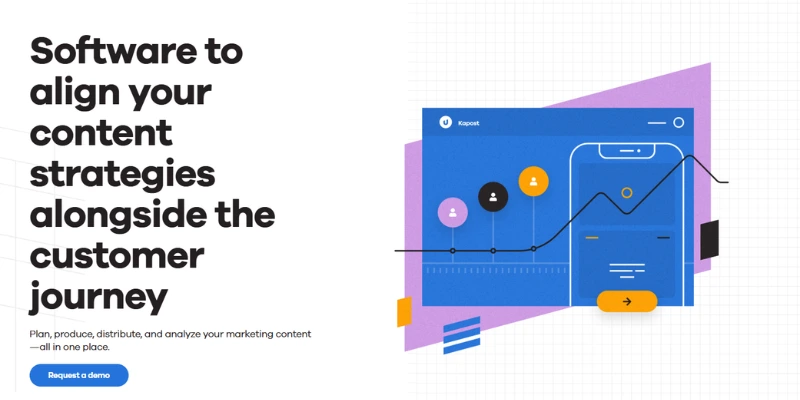
Best for: Managing complex B2B content workflows
Kapost is built for organizations that need to align content with business goals and sales processes.
B2B enterprises with long sales cycles and content-driven pipelines.

Best for: Global campaign management
Percolate enables enterprises to coordinate large-scale marketing campaigns across regions and teams.
Global organizations managing multiple brands or regional campaigns.
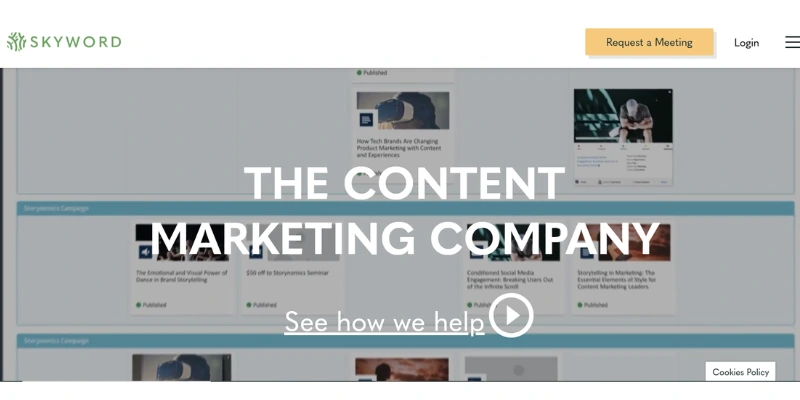
Best for: Multimedia and creative content production
Skyword combines AI tools with a global network of creators, enabling diverse content formats beyond text.
Brands focused on storytelling through video, design, and interactive content.
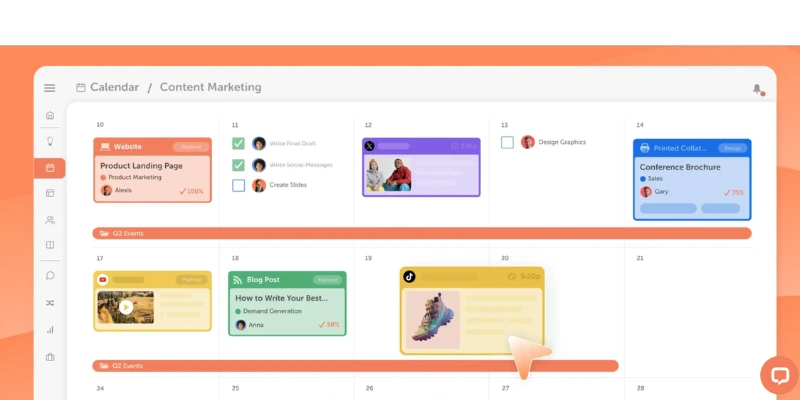
Best for: Growing teams seeking affordable automation
CoSchedule offers a simpler, more accessible solution for teams that need workflow organization and social automation without enterprise complexity.
Mid-sized teams transitioning from manual processes to structured workflows.
| Platform | Best For | AI Capabilities | Enterprise Ready | Pricing |
|---|---|---|---|---|
| Sight AI | AI search optimization | Advanced (AI + visibility) | Yes | Custom |
| Jasper | Brand voice consistency | Strong generation | Yes | Mid–High |
| Writer | Compliance & governance | Controlled AI | Yes | Mid–High |
| Contently | Content + talent network | Moderate | Yes | Custom |
| Acrolinx | Content governance | AI scoring + control | Yes | Custom |
| Kapost | B2B operations | Workflow-focused | Yes | Custom |
| Percolate | Campaign orchestration | Moderate | Yes | Custom |
| Skyword | Creative + multimedia | AI-assisted | Yes | Custom |
| CoSchedule | Mid-market teams | Basic automation | Limited | Low–Mid |
While automated content platforms offer significant advantages, relying solely on off-the-shelf tools comes with limitations that enterprises must carefully consider. Understanding these gaps is essential for making informed decisions and building a sustainable content strategy.
One of the most common challenges with AI tools is the production of generic, repetitive content. Since many platforms rely on similar underlying models, the output often lacks differentiation.
This becomes a serious issue in competitive industries where:
Generic content may fill volume requirements, but it rarely builds brand equity or long-term visibility.
Although many tools offer “brand voice” features, they are often limited in depth. They can mimic tone to an extent, but they struggle to fully capture:
As a result, content may sound consistent—but not truly distinctive.
Most SaaS platforms are designed for broad usability, which means customization is inherently limited. Enterprises often face challenges such as:
For organizations with complex requirements, these limitations can become bottlenecks.
Relying entirely on third-party tools introduces risks:
As content becomes a core business asset, dependence on external systems can restrict long-term flexibility and innovation.
Perhaps the most critical limitation is that tools focus on features, not outcomes. They help generate content, but they do not inherently align with:
This gap is why many enterprises eventually move beyond tools and invest in more tailored solutions.
Understanding these limitations is not about dismissing AI tools—it’s about recognizing where they fit and where they fall short. For organizations aiming to build a competitive advantage, the next step is not just adopting automation, but evolving toward systems that are fully aligned with their business strategy.
Automated content tools have undoubtedly transformed how businesses create and distribute content. However, relying entirely on off-the-shelf platforms introduces limitations that become more visible as organizations scale. For enterprises aiming to build long-term competitive advantage, these gaps cannot be ignored.
Most AI tools are built on shared foundational models. While they are capable of producing grammatically correct and structured content, the output often lacks originality.
This results in:
In highly competitive markets, generic content does not just underperform—it becomes invisible.
Many platforms offer brand voice features, but these are often surface-level. They can replicate tone patterns but struggle with deeper elements such as:
As a result, businesses may achieve consistency, but not distinction. Over time, this weakens brand authority.
SaaS-based AI tools are designed for scalability across multiple users, which limits customization at the enterprise level. Organizations often face constraints such as:
For enterprises with complex operations, these limitations slow down innovation rather than enabling it.
Relying on third-party tools introduces long-term risks:
As content becomes a core business asset, depending entirely on external platforms can restrict flexibility and strategic control.
The biggest limitation is not technical—it’s strategic.
AI tools help generate content, but they do not inherently align with business goals, revenue objectives, or competitive positioning. This creates a gap between content production and business impact.
This is where leading enterprises begin to shift their approach.
.webp)
For many organizations, AI tools serve as a starting point. But as content becomes central to growth, enterprises are moving beyond tools and investing in custom AI content systems built specifically for their business.
The reason is simple:
Tools solve short-term execution problems. Custom AI systems create long-term scalability and competitive advantage.
Every organization has unique processes—content planning, approvals, publishing cycles, and distribution strategies. Custom AI systems are built to align with these workflows rather than forcing teams to adapt to predefined structures.
This enables:
Unlike generic tools, custom systems can be trained on:
This results in AI that does not just generate content—but produces content that reflects the organization’s identity and expertise.
With custom AI systems, enterprises retain full control over:
This eliminates dependency on external platforms and ensures that content operations remain aligned with internal policies and long-term strategy.
The most important benefit is differentiation.
While competitors rely on the same tools, organizations with custom AI systems operate on a completely different level. They can:
This is why enterprises are increasingly partnering with an experienced AI Automation Development Partner to build tailored solutions.
Additionally, choosing the right AI Development services companies ensures that the system is scalable, secure, and aligned with business objectives.
Building an automated content system is not about implementing a single tool. It requires a structured approach that combines strategy, technology, and execution.
Start by identifying what you want to achieve:
Clear goals ensure that automation aligns with business outcomes.
Select models based on your requirements:
The choice of model directly impacts quality and scalability.
Feed the system with:
This step is critical for achieving relevance and uniqueness.
Design workflows that connect:
Automation should reduce manual intervention while maintaining control.
Connect your AI system with:
Integration ensures seamless data flow and operational efficiency.
Content must be structured for both traditional SEO and AI-driven platforms. This includes:
As organizations scale, trends such as AI Agent Adoption in Tech Companies are further enhancing automation by enabling autonomous content workflows.
Automated content systems are not limited to one sector. Their impact is being felt across industries, particularly in markets like the UAE where digital transformation is accelerating.
Hospitals and healthcare providers use AI to:
Real estate businesses leverage automation for:
E-commerce companies benefit from:
SaaS companies use AI to:
These use cases highlight how AI adapts to different business models. Enterprises looking to implement such solutions often explore AI developement for every industries to ensure their systems are tailored to specific operational needs.
The next phase of content automation is already taking shape, driven by advancements in AI capabilities and enterprise adoption.
AI agents are evolving from simple assistants to autonomous systems capable of:
This reduces human involvement in repetitive tasks while increasing efficiency.
Content is no longer limited to text. AI systems are now capable of generating:
This enables brands to create richer, more engaging experiences.
The ultimate goal is fully autonomous content ecosystems where:
These systems continuously improve, creating a self-sustaining content engine.
Selecting the right approach requires a clear understanding of your current needs and future goals.
While tools may appear cost-effective initially, custom systems often deliver better ROI over time due to efficiency and control.
Consider how the solution fits within your existing ecosystem. Seamless integration is essential for maximizing value.
Automated content and copywriting is no longer optional—it is becoming the foundation of modern content strategy. Businesses that continue to rely solely on manual processes or basic tools will struggle to compete in a landscape defined by speed, scale, and intelligence.
The real opportunity lies in moving beyond tools and building systems that are aligned with your business goals, workflows, and brand identity.
If you are looking to scale your content operations, improve efficiency, and gain a competitive edge, the next step is to invest in a solution tailored to your needs.
Consult with specialists who can guide you through building scalable AI-driven systems.




Start Build Your
Next Digital Solution?
Let’s build scalable, future-ready digital solutions tailored to your business goals. Connect with our experienced technology consultants to discuss your vision, strategy, and growth opportunities — with zero obligation and complete transparency.
Get a free consultation and cost estimate for your digital solution
Our expert will contact you within 24 hours. Check your email for confirmation.
Partner with SISGAIN experts to build secure, scalable AI-powered IT Solutions that transform your business operations.









DUQE FREEZONE Quarter Deck, Queen Elizabeth 2, Mina Rashid, Dubai, UAE

100 Consilium Pl Suite 200, Scarborough, ON M1H 3E3, Canada

C-109, Sector 2, Noida, Uttar Pradesh 201301 India
Project quotes, partnerships, implementation
Open roles, referrals, campus hiring