
 +1 844-445-5767
 +971 56-848-5757
 +91 921-208-0630
For Business & Service Inquiries
Sales Team
Project quotes, partnerships, implementation
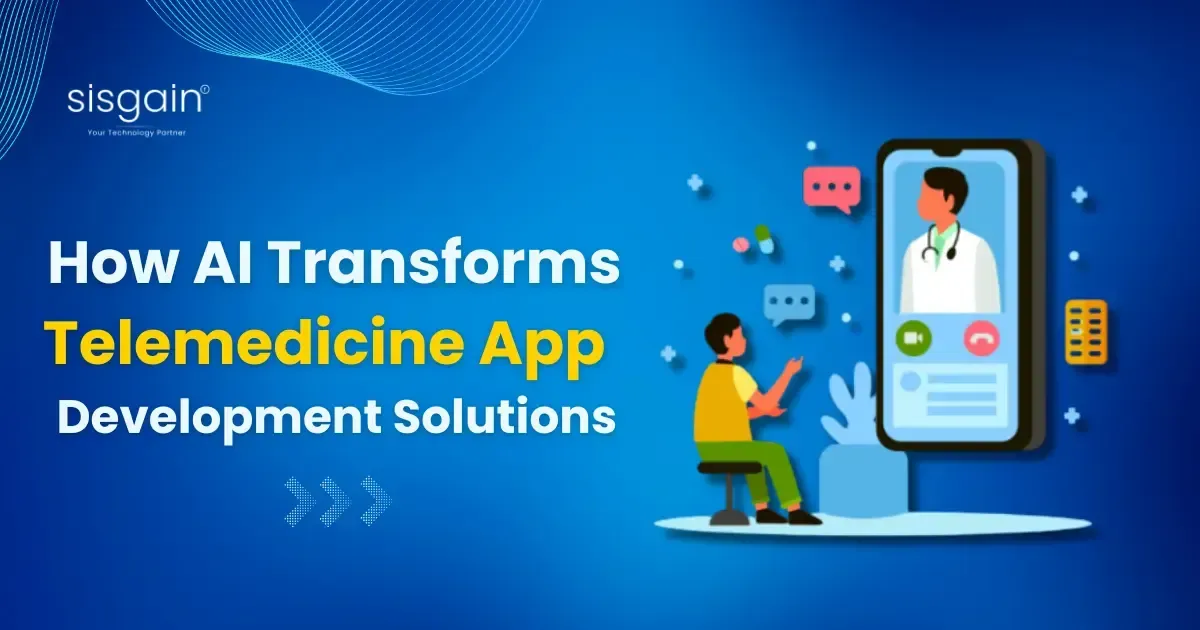
Every minute delay in diagnosis can cost a life—yet most telemedicine apps still operate like basic video calling tools. A patient in a rural town develops early symptoms of a cardiac issue. In a traditional telemedicine system, they wait hours—or even days—for consultation, manual triage, and diagnosis.
But in an AI-powered telemedicine system, the same patient is:
No delays. No guesswork. No overload on doctors. This is no longer a future concept—it is already happening.
Healthcare organizations adopting AI in telemedicine are reporting $20–100 million in annual savings, 41% reduction in documentation time, and up to 94% diagnostic accuracy in AI-powered imaging systems. At the same time, the global AI in telemedicine market is projected to grow from $26.11 billion (2025) to $176.94 billion by 2034, signaling a massive shift in how digital healthcare systems are being built.
This raises a critical question: Why are most telemedicine apps still built like it’s 2015?
In this blog, we break down how AI transforms telemedicine app development solutions, what real-world systems are already doing today, and how to build scalable, intelligent healthcare platforms that deliver clinical value and rank in today’s AI-driven ecosystem.
Most telemedicine platforms still do three things:
While these features helped digitize healthcare communication, they do not fundamentally improve how care is delivered. In reality, they have only shifted in-person processes into digital formats without adding intelligence, prediction, or automation. This is why many existing systems are struggling to meet modern healthcare demands.
For example : AtlantiCare reduced physician documentation time by 41% using AI automation, saving over 66 minutes per doctor per day.This demonstrates that the problem is not just inefficiency—it is a structural limitation of traditional systems.
Without AI, telemedicine platforms function only as communication tools. With AI integration, however, they evolve into clinical intelligence systems capable of prediction, automation, and decision support—fundamentally transforming healthcare delivery.
If you want to understand how leading solutions in this space are evolving, explore some of the best telemedicine platforms and companies shaping modern digital healthcare.


Modern AI systems in telemedicine are no longer limited to basic chatbot interactions. Instead, they function as first-line clinical decision support systems that actively assist in patient evaluation, prioritization, and care routing. This shift significantly reduces dependency on manual intake processes and improves the speed and accuracy of early medical decisions.
Natural Language Processing (NLP) currently holds around 32% market share in AI telemedicine systems, highlighting its importance in enabling human-like interaction and clinical understanding at scale.
A practical example can be seen in AI-based symptom checker platforms, where patient inputs are compared against millions of anonymized clinical records to generate early risk assessments even before a physician joins the consultation.
Today, AI-powered triage is no longer an optional enhancement. In modern AI telemedicine app development solutions, it has become a core foundational feature for scalable and efficient healthcare delivery.
AI-powered predictive analytics shifts healthcare from reactive to preventive care by identifying risks before a condition becomes serious.
In telemedicine systems, AI analyzes patient history, reports, wearables, and vital trends to detect hidden patterns that doctors may miss during routine checks, enabling early intervention and better outcomes.
P(disease risk) = f(history,biometrics,behavior,genetics)
A strong example comes from Mount Sinai Health System, where an AI-powered predictive model for malnutrition risk delivered an estimated $20 million impact by enabling earlier clinical intervention and improving patient outcomes.
This transformation is one of the most powerful outcomes of modern AI telemedicine app development solutions, fundamentally redefining how healthcare systems identify and manage patient risk.
Medical imaging is one of the most advanced areas where AI is transforming healthcare. AI diagnostic tools are now assisting and, in some cases, outperforming human accuracy under real-world conditions.
Even patients in rural or underserved regions can now receive diagnostic accuracy comparable to major hospitals through remote systems.
This makes AI diagnostic tools one of the strongest value drivers in modern AI-powered telemedicine app development solutions.
AI remote patient monitoring enables a shift from episodic healthcare (occasional visits) to continuous, real-time care. Instead of relying on periodic checkups, patients are monitored constantly through connected devices, allowing healthcare providers to detect issues early and intervene immediately when needed.
Devices involved: Smartwatches, ECG monitors, Glucose sensors, Blood pressure cuffs.
AI processes the continuous flow of patient data in real time and transforms it into actionable clinical insights by:
NYU Langone Health demonstrated the financial and clinical value of this approach with its remote hypertension monitoring program, achieving a 22.2% return on investment (ROI).
Results - Patients receive continuous medical supervision without needing continuous hospital visits, improving outcomes while reducing overall healthcare costs and system burden.
AI removes one of healthcare’s biggest limitations: one-size-fits-all treatment by enabling truly personalized care for each patient.
It analyzes multiple patient-specific factors such as genetics, past treatments, drug response history, and clinical records to understand how an individual is likely to respond to different therapies.
AI Analyzes: Genetics, Past treatments, Drug response history, Clinical records
Output: Personalized treatment recommendations for each patient
Key Benefits: Improved treatment adherence, Faster recovery rates, Higher patient trust
Doctors don’t want to spend time typing notes—they want to focus on treating patients. AI solves this through NLP-powered clinical documentation systems that automate and streamline the entire documentation process.
Hospitals using AI documentation tools report:
Result: Doctors spend less time on paperwork and more time on patient care.

AI in telemedicine is no longer just a clinical advancement — it has become a direct driver of financial efficiency and operational optimization for healthcare organizations.
|
Metric |
Traditional System |
AI-Powered System |
|
Diagnosis Time |
Hours / Days |
Minutes |
|
Documentation Load |
3–4 hours/day |
1–2 hours/day |
|
Readmission Rate |
High |
~20% reduction |
|
Diagnostic Accuracy |
~65% |
~94% |
AI is no longer a simple add-on in healthcare platforms. It has evolved into a core infrastructure layer that reduces costs, improves efficiency, and significantly enhances both clinical outcomes and financial performance.
This is why many organizations choose to partner with SISGAIN, a trusted custom AI development company, to build scalable, secure, and compliant healthcare solutions.
A strong AI telemedicine platform must be built on intelligence, automation, and compliance to ensure scalable, efficient, and reliable healthcare delivery in 2026.
Without these capabilities, a telemedicine platform cannot compete in today’s AI-driven healthcare ecosystem. Modern healthcare solutions are expected to be intelligent, predictive, and fully compliant by design, not as an afterthought.
Data Privacy Risks: These arise when sensitive patient data is exposed or misused. They are solved by implementing strong encryption, secure cloud infrastructure, and a compliance-first design approach (HIPAA/GDPR standards).
AI Bias: This occurs when AI systems produce unfair or inaccurate outputs due to unbalanced data. It is solved by using diverse training datasets and continuous clinical validation to ensure accuracy across different patient groups.
Legacy System Integration: Many healthcare systems use outdated software that doesn’t easily connect with modern AI tools. This is solved using API-first architecture and modular system design for smooth integration.
Trust in AI Decisions: Clinicians and patients may hesitate to rely on AI if decisions are unclear. This is solved with explainable AI (XAI), which provides transparent reasoning behind every output.
High Development Cost: AI healthcare systems can be expensive to build initially. This is solved through an MVP-first rollout strategy and phased development to reduce risk and validate results early.
Ask these questions before hiring:
Most vendors fail here, which is why choosing an experienced AI telemedicine app development company like SISGAIN becomes critical. The difference is execution depth, not marketing.
AI is no longer just enhancing telemedicine—it is fundamentally redefining how it works.
The healthcare industry is shifting from:
Organizations adopting AI telemedicine systems today are not simply improving efficiency. They are building the core infrastructure of future healthcare delivery, where intelligence, automation, and continuous care become the new standard.


Start Build Your
Next Digital Solution?
Let’s build scalable, future-ready digital solutions tailored to your business goals. Connect with our experienced technology consultants to discuss your vision, strategy, and growth opportunities — with zero obligation and complete transparency.
Get a free consultation and cost estimate for your digital solution
Our expert will contact you within 24 hours. Check your email for confirmation.
Partner with SISGAIN experts to build secure, scalable AI-powered IT Solutions that transform your business operations.









DUQE FREEZONE Quarter Deck, Queen Elizabeth 2, Mina Rashid, Dubai, UAE

100 Consilium Pl Suite 200, Scarborough, ON M1H 3E3, Canada

C-109, Sector 2, Noida, Uttar Pradesh 201301 India
Project quotes, partnerships, implementation
Open roles, referrals, campus hiring