
 +1 844-445-5767
 +971 56-848-5757
 +91 921-208-0630
For Business & Service Inquiries
Sales Team
Project quotes, partnerships, implementation
The healthcare industry is changing rapidly in 2026. The growing trend of digital health solutions, the increasing demand for telemedicine and AI-based tools, and the strict regulations have made more clinics, hospitals, and health-tech companies invest in custom software than ever before.
If you are going to build a new healthcare application or improve your existing systems, the first big question is always the same – how much will it cost?
Healthcare software development costs in 2026 can be very different depending on what you are building. A simple healthcare app can start from around $30,000, while large and complex systems like hospital management software or full hospital networks can go above $500,000.
The reason for this big difference is the type of features and requirements involved. Healthcare software must follow strict rules like HIPAA and GDPR, which are made to protect patient data. If the system needs to connect with other tools, include advanced features, or handle sensitive medical information safely, the cost increases.
In simple words, the more features, security, and compliance needed, the higher the cost of development.
In this comprehensive pricing guide, I’ll walk you through realistic cost breakdowns, key factors that affect your budget, different types of healthcare software, and practical ways to reduce costs. You’ll also learn how to pick the right partner and avoid common pitfalls.
If you are a small clinic owner or a part of a big healthcare organization, it is crucial to know these costs when you are considering healthcare software development services.
This guide aims to provide you with clear, transparent, and up-to-date information from current industry trends to help you make confident and informed decisions for your project.
If you've ever built a regular mobile app or a simple business tool, you might be surprised by how much more expensive healthcare software turns out to be. In 2026, developing healthcare software isn't just about writing clean code and launching a nice interface—it's about navigating a minefield of regulations, security requirements, and life-critical reliability standards.
So why does it cost significantly more?
The biggest reason is compliance. Healthcare software that handles patient data must follow strict rules like HIPAA in the US (and similar regulations like GDPR in Europe). This isn't something you can add at the end—it has to be baked into the architecture from day one.
According to recent industry reports, HIPAA compliance alone can add 15-30% to the total development cost. This includes:
One small mistake here can lead to massive fines or even legal trouble, so teams spend a lot more time on planning, documentation, and testing than they would for a regular e-commerce app.
Unlike a general app where a data breach might be embarrassing, in healthcare it can be dangerous. That's why healthcare projects demand multiple layers of security—secure authentication, vulnerability scanning, and strict data isolation. These requirements push development time and costs much higher than standard software.
Healthcare doesn't work in isolation. Your new software often needs to talk to existing systems like Electronic Health Records (EHRs), laboratory systems, billing platforms, or wearable devices. Standards like FHIR and HL7 make this possible, but integrating them properly is complex and time-consuming.
AI is transforming healthcare—from predictive diagnostics to personalized treatment plans. While this creates exciting opportunities, adding AI in healthcare software also increases costs because of specialized data training, model validation, and extra compliance checks for AI decisions.
Yes, AI can deliver big long-term savings through efficiency and better outcomes, but the upfront investment is noticeably higher.
These increasing costs and complexities are also a direct result of how rapidly software is transforming healthcare systems. For a deeper understanding of this shift, read Why Software Is Advancing the Healthcare Industry.
Here's a realistic side-by-side look at how costs typically break down in 2026:
|
Aspect |
General Software |
Healthcare Software |
Why the Difference? |
|
Basic MVP Cost |
$15,000 – $60,000 |
$30,000 – $80,000+ |
Compliance & Security |
|
Compliance & Security |
Minimal |
15-30% extra |
HIPAA + Audits |
|
Integrations |
Simple APIs |
Complex (EHR, FHIR, Devices) |
Interoperability needs |
|
Testing & Validation |
Standard QA |
Extensive (Clinical + Security) |
Patient safety |
|
Timeline |
2-4 months |
3-8+ months |
Extra documentation |
The healthcare digital transformation is accelerating rapidly in 2026, with massive investments happening across hospitals, clinics, and startups. While the initial costs are higher, well-built healthcare software often delivers strong returns through improved efficiency, better patient care, and reduced manual work.
Understanding these differences helps you set realistic expectations and choose the right approach from the beginning.
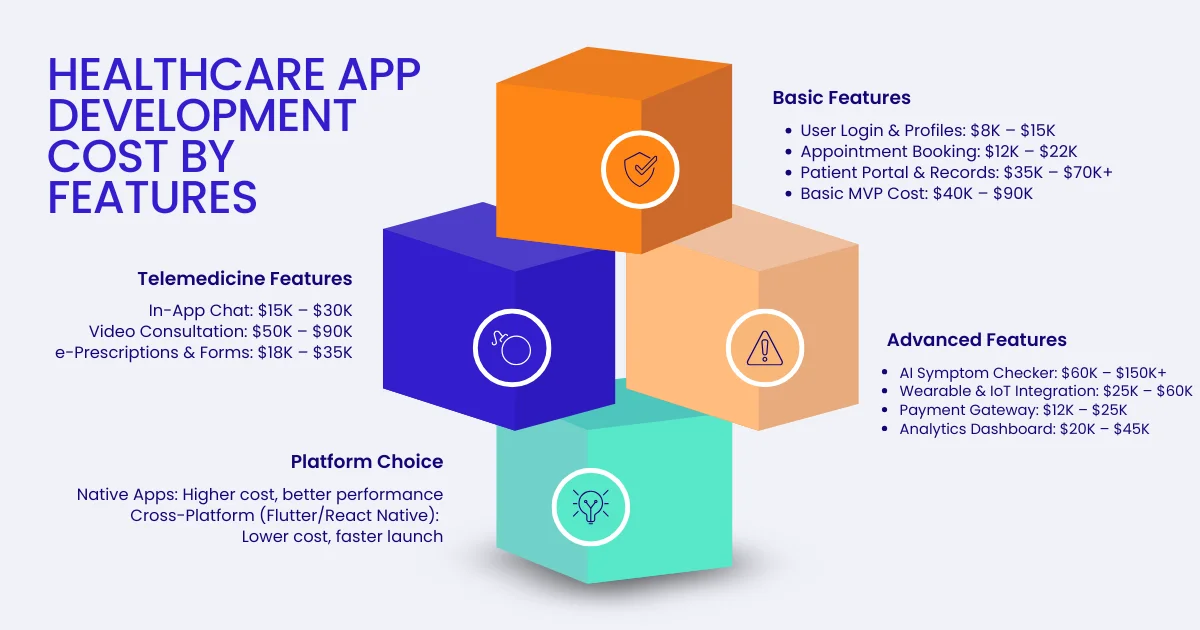
If you're wondering about the cost to build a healthcare app in 2026, you're not alone. Most clinic owners, startup founders, and healthcare administrators I talk to get overwhelmed by the wide price ranges they see online. The truth is, the final cost depends heavily on what features you actually need.
Here’s a realistic, feature-by-feature breakdown based on current 2026 market rates. These numbers assume a professional development team (including designers, developers, QA, and compliance experts) and proper security standards.
These are the must-have elements for most apps:
A simple MVP with just these core features usually falls in the $40,000–$90,000 range.
This is where costs start climbing quickly because of real-time requirements and high security needs.
This decision can significantly impact your budget:
Starting with cross-platform can save you a good chunk of money while still delivering excellent performance for most healthcare use cases.
When you move from small clinic software to full enterprise healthcare systems, the cost goes up quite a lot. In 2026, building large platforms like advanced EHR/EMR systems—which include things like patient records, billing, inventory, analytics, and compliance—usually costs somewhere between $300,000 and $1 million+.
This price is not just because of extra features. Enterprise healthcare software is built for heavy, real-world hospital use. It has to handle a large number of patients, support different departments, and run smoothly without downtime. On top of that, it must be highly secure and follow strict healthcare rules.
Simply put, the bigger and more complex the system, the more time, effort, and money it takes to build it properly.
Why does enterprise healthcare software cost so much more?
Real-World Examples
Think about the difference between two common scenarios:
The gap between these two isn’t just size — it’s the level of complexity, reliability, and future-proofing required.
That said, the final cost heavily depends on your specific needs and how you approach the project. This is exactly where partnering with a reliable custom software development company can make a big difference. An experienced team can help you avoid unnecessary features, suggest smart integrations, and deliver a scalable solution without inflating the budget.
If you are planning to build healthcare software in 2026, it is important to first understand what really affects the cost. Healthcare apps are not like normal apps—they need more safety, more rules, and more care. Because of this, even a small change in features or requirements can increase the cost by a large amount, sometimes by tens of thousands of dollars.
There are many key factors that decide the final development cost. These include the type of features you want, the level of security needed, compliance with healthcare rules, and how complex the system is. Each of these things can directly increase or decrease your overall budget depending on your choices.
The cost mainly depends on how many features you want. In simple terms, more features means higher cost.
For example, a basic app that only allows patients to book appointments is much cheaper than a full telemedicine platform that includes video calls, online prescriptions, chat, and live notifications.
In most cases, this is the biggest factor affecting the total budget. Just adding features like real-time updates or multiple user roles can increase the overall cost by around 40% to 70% or even more.
Compliance isn’t optional—it's mandatory. In 2026, meeting HIPAA standards (and GDPR if you serve European patients) remains one of the biggest cost add-ons.
This includes secure data encryption, audit logs, consent management, regular security audits, and proper documentation.
Impact: HIPAA compliance alone typically adds 15-30% to the total project cost. In complex cases, it can go up to 50%. Skipping this or trying to add it later is much more expensive.
Healthcare software usually doesn’t work alone. Most of the time, it needs to connect with other systems like EHR/EMR systems, lab software, wearable devices, billing tools, or pharmacy systems.
These connections are important because they help different systems share patient data smoothly. But they also increase the cost.
For example:
In short, the more systems you connect, the higher the development cost becomes.
Choosing modern technologies can increase costs but also deliver better long-term value.
Impact: AI/ML features can add 20-40% to the budget, depending on how advanced they are.
Where your development team is based also plays a big role in the overall cost of healthcare software.
For example:
In many cases, choosing the right custom software development company in a cost-effective location can reduce the total budget by around 40% to 60%, without reducing quality.
However, one important thing to remember is that you need good project management. This helps manage communication, especially when teams are in different time zones.
Healthcare users (doctors, patients, and nurses) need clean, intuitive, and accessible interfaces. Poor design leads to low adoption.
Thorough testing—especially security, performance, and usability testing—is non-negotiable.
Impact: Professional UI/UX design + extensive testing (including accessibility and penetration testing) can account for 15-25% of the total budget.
Many people miss this part, but it is very important. After your healthcare software is launched, the work doesn’t stop. You will still need regular maintenance, security updates, fixing bugs, adding new features, and paying for servers or cloud services.
These ongoing costs are a normal part of running the software.
The key to controlling costs in 2026 is prioritization. Start with an MVP, focus on must-have features first, and choose the right healthcare software development services partner who understands both technology and compliance.
Artificial intelligence has become one of the biggest game-changers in healthcare software—and also one of the most expensive additions. In 2026, adding meaningful AI capabilities to your healthcare platform isn’t cheap, but when done right, it often delivers one of the strongest returns on investment you can get.
Integrating AI isn’t like adding a simple new feature. It comes with several hidden layers of cost:
Realistically, adding solid AI features can increase your overall project cost by 20-40% compared to a non-AI version. For complex features like diagnostic assistance or predictive analytics, the premium can go even higher.
The good news? Organizations that implement AI thoughtfully are seeing strong ROI—often within 12-18 months.
Key benefits include the following:
Many healthcare providers report $3.20 in return for every $1 invested in well-executed AI projects, with some seeing payback periods as short as 14 months.
If you're planning to add AI features, I strongly recommend starting with a focused use case rather than trying to make everything "AI-powered" from day one. This keeps costs manageable and delivers faster wins.
Want to go deeper? Check out our detailed guide on AI in healthcare software, where we explore specific tools, implementation strategies, and success stories.
Analytics has become a very important part of modern healthcare software. Without proper analytics, even well-built systems end up collecting a lot of data, but very little useful insight.
In 2026, healthcare organizations use analytics to improve patient care, reduce costs, manage population health, predict risks in advance, and meet compliance requirements.
Good analytics tools convert raw data from sources like EHR systems, wearables, billing platforms, and lab systems into simple dashboards and meaningful insights.
However, selecting and integrating the right analytics tools can significantly increase the overall development cost of the project.
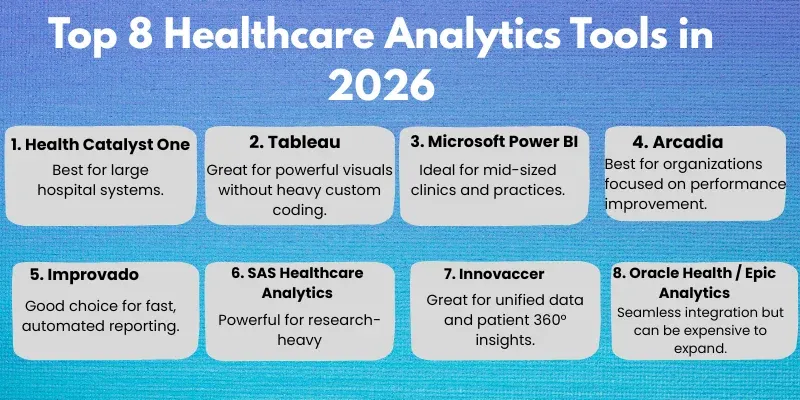
Here’s a practical look at the Top 8 Healthcare Analytics Tools in 2026, along with their typical integration costs and how they affect your project:
Adding analytics is not just a small extra feature—it can significantly increase the cost of healthcare app development by around 15% to 35%, depending on how advanced the setup is.
For example:
There are also ongoing costs to consider, such as tool licenses, data handling work, staff training, and maintenance, which usually add about 18% to 25% per year.
The most important thing is choosing tools based on your real needs. Many teams overspend by using expensive enterprise solutions when simpler tools like Power BI could handle most of the work. At the same time, choosing overly cheap solutions can lead to poor data quality and costly fixes later.
So, while planning your project with a custom software development company or healthcare software development services, it’s important to work with a team that has real experience in analytics integration. The right decision not only helps control costs but also improves efficiency and delivers faster ROI through better insights.
Most people think that the main cost of healthcare software is only the development cost. But in 2026, that is not the full picture. The money you spend at the start is just the beginning.
After the software is launched, there are extra costs that often come as a surprise. These include maintenance, security updates, bug fixing, server or cloud expenses, and adding new features over time.
If these costs are not planned in advance, the total budget can go much higher than expected. That is why it is important to understand these hidden expenses early, so you can plan better and avoid financial surprises later..
Here are the biggest ongoing expenses you should plan for:
These hidden costs can easily push your total ownership expense 1.5x to 2x the original development budget over 3–5 years.
The good news? You can control these expenses without compromising quality. Here are proven strategies that actually work in 2026:
Before you sign any contract, run a quick ROI check. Here’s a straightforward way to do it:
Basic ROI Formula:
ROI = [(Total Benefits - Total Costs) / Total Costs] × 100
What to Include:
Example: If you invest $120,000 in a patient management system that saves your clinic $85,000 per year in operational costs, your ROI in the first year would look very healthy.
Take time to build a 3-year projection spreadsheet. Many experienced developers can help you create this during the discovery phase.
Choosing the right development partner is one of the most important decisions in your healthcare software project. A good team can save you time, money, and headaches, while the wrong one can lead to delays, compliance issues, and poor-quality software.
Don’t hesitate to ask these straightforward questions:
Working with a dedicated healthcare software development services provider or an experienced custom software development company makes a big difference. They already understand complex healthcare workflows, patient privacy rules, and industry-specific challenges. This leads to better solutions, fewer mistakes, and smoother development.
Instead of teaching a general team about healthcare, you get experts who can suggest smart ideas, especially around AI in healthcare software, and help control overall costs.
The right partner acts as your technology advisor, not just a coding service. If you're planning to build healthcare software in 2026, take time to choose wisely.
Ready to take the next step? Share your project requirements in the comments or contact us for a custom quote made for your needs.
SISGAIN is a trusted healthcare software development partner with proven expertise in building secure, scalable, and compliant digital health solutions. The team specializes in HIPAA/GDPR-ready architecture, seamless EHR integrations, and AI-driven healthcare innovation. SISGAIN provides reliable and cost-effective solutions to meet the clinical and enterprise needs with deep domain experience and agile delivery.
To summarize, healthcare software development in 2026 can cost anywhere from $30,000 for a simple app to more than $500,000 for advanced enterprise systems.
The final cost depends on several key factors like the features you include, regulatory compliance needs, AI integration, and the level of security required.
The best approach is to plan smartly—start with an MVP (basic version), focus on essential features first, and then expand step by step with the right development team. This helps you control costs while still maintaining good quality.
If you are planning to build healthcare software, this is the right time to clearly understand your needs. Whether you are a clinic owner or a health tech startup, choosing the right custom software development company or healthcare software development services can save both time and money in the long run.




Start Build Your
Next Digital Solution?
Let’s build scalable, future-ready digital solutions tailored to your business goals. Connect with our experienced technology consultants to discuss your vision, strategy, and growth opportunities — with zero obligation and complete transparency.
Get a free consultation and cost estimate for your digital solution
Our expert will contact you within 24 hours. Check your email for confirmation.
Partner with SISGAIN experts to build secure, scalable AI-powered IT Solutions that transform your business operations.









DUQE FREEZONE Quarter Deck, Queen Elizabeth 2, Mina Rashid, Dubai, UAE

100 Consilium Pl Suite 200, Scarborough, ON M1H 3E3, Canada

C-109, Sector 2, Noida, Uttar Pradesh 201301 India
Project quotes, partnerships, implementation
Open roles, referrals, campus hiring